
In defense of abolition
Resisting the backlash

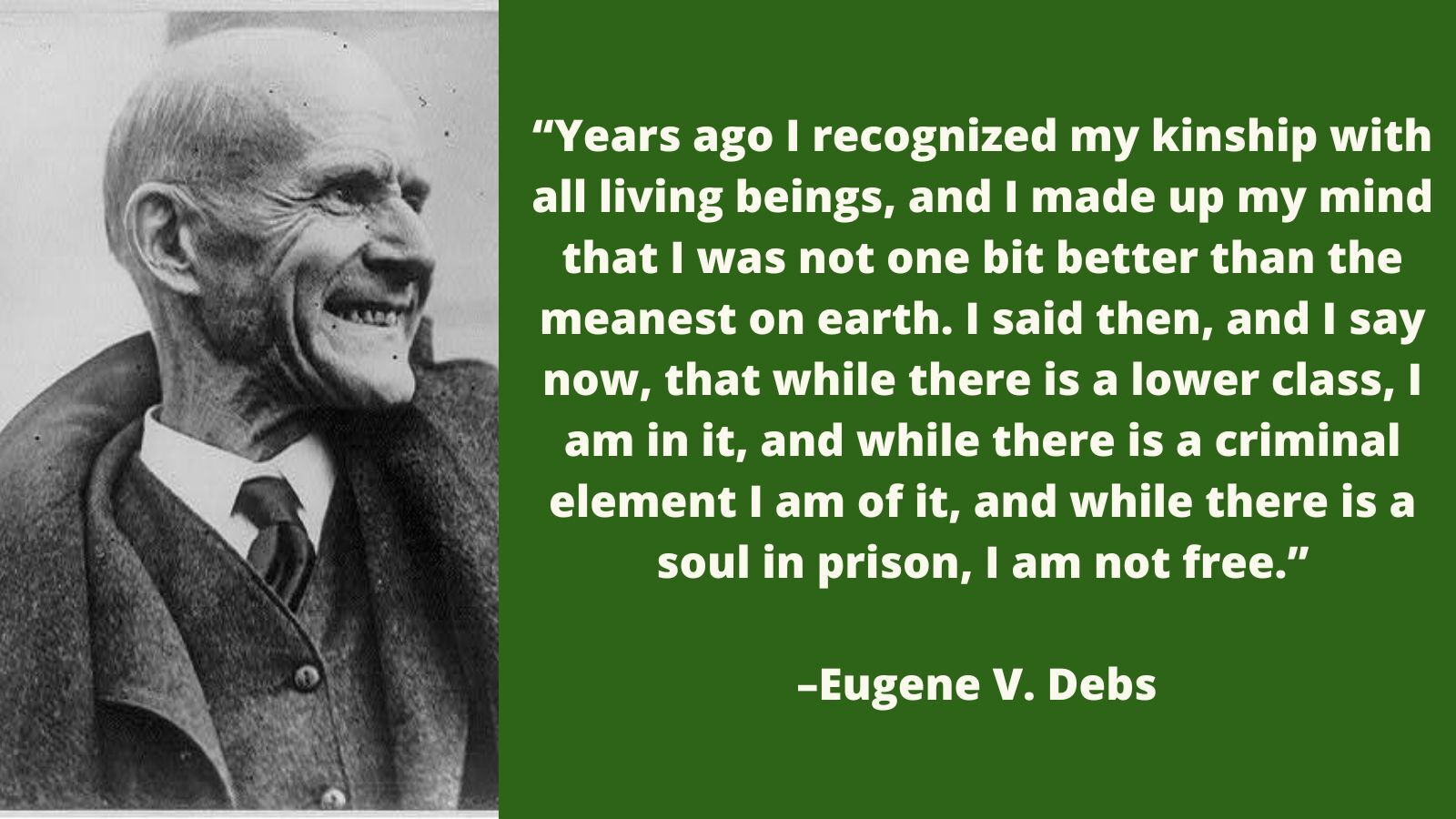
Years ago I recognized my kinship with all living beings, and I made up my mind that I was not one bit better than the meanest on earth. I said then, and I say now, that while there is a lower class, I am in it, and while there is a criminal element I am of it, and while there is a soul in prison, I am not free.
–Eugene V. Debs
Six years ago, the racist police murder of George Floyd sparked the biggest uprising in the history of the United States. Across the country, over 26 million people poured into the streets for months in a mass multiracial movement against the police and jails that enforce U.S. capitalism’s class and social inequalities.
Calls to defund and abolish the police emerged as organic demands of the movement. The burning down of a Minneapolis police precinct proved more popular than both presidential candidates. Faced with a profound crisis of legitimacy, the two capitalist parties each in their own way launched a counteroffensive to shore up and expand the police state at the core of our bourgeois democracy.
Tragically, some on the Left have adapted to the backlash. Alexandria Ocasio-Cortez recently ridiculed the movement and its demands, quipping “woke 1.0 was crazyyyyy,” while Jacobin writers such as Paul Heideman, Eric Blanc, Ben Burgis, and Dustin Guastella have come out against defund and abolition in the name of what they describe as “mass politics.”
Their position is not only profoundly mistaken, but dangerous. Their echoing of ruling-class attacks on abolitionism and support for the police surrenders the ideological ground won by the 2020 rebellion, undermines the struggle against President Trump’s authoritarianism, and impedes the fight for socialism.
Ruling Class Backlash
Their arguments must be understood in the context of the bipartisan backlash against Black Lives Matter. Each party has played its traditional role. In 2020, President Trump and his Republican Party assassinated the character of George Floyd, demonized BLM activists as terrorists, defended the police, rallied support for racist counterdemonstrations, turned vigilante Kyle Rittenhouse into a right-wing hero, and even threatened to deploy troops to repress protests.
The Democrats, of course, pretended to be the movement’s ally, with lifetime supporters of policing like Nancy Pelosi donning kente cloth and bending her knee in the Capitol building. Mayors painted Black Lives Matter on city streets and enacted corporate Diversity, Equity, and Inclusion (DEI) measures. They did so to co-opt the struggle and turn Black Lives Matter into Black Votes Matter for Joe Biden. The ruling class demobilized the movement, opening the door for both parties to increase funding for cops, ICE, CBP, and the FBI.
From Compassionate Policing to Authoritarianism
Once in power, President Biden vowed to “fund, fund, fund the police.” He escalated the bipartisan war on migrants–shutting down the border, continuing the construction of Trump’s border wall, and ramping up deportations. Biden and Democratic governors and mayors proposed and, in many cases, passed bills named after George Floyd. These dramatically increased funding for policing and prisons under cover of fake reforms like community policing, body cameras, and professional training. Under Trump and Biden, national police expenditure increased by forty percent.
The Democrats thereby re-legitimized and enacted the right’s law-and-order agenda. This has led to an increase in police murders every year since 2020 and paved the way for the return of the racist-in-chief Donald Trump and his white supremacist Republican Party. Despite the national drop in crime, Trump seized the opening provided by the Democrats, whipping up a racist moral panic over false claims about lawlessness, lies about Black criminality, nonsensical allegations of “reverse racism” against DEI, and a xenophobic assault on immigrants.
Trump has funded, expanded, and weaponized the police state to an unprecedented degree. His “Big Beautiful Bill” poured $75 billion into the coffers of ICE to abduct immigrants and throw them into concentration camps. He deployed the National Guard to patrol Washington, D.C. in search of nonexistent criminals, reducing them to weeding the city’s unkempt gardens.
He deployed his ICE Gestapo in city after city as an occupying army, resulting in the murders of Renee Good, Alex Pretti, Lorenzo Salgado Araujo, Johan Sebastian Duran Guerrero, Silverio Villegas González, and Isaias Sanchez Barboza, to name only a few. Many more have died in ICE concentration camps. When the killing of Good and Pretti triggered a city-wide uprising and a national day of protest, Trump unleashed his beefed-up surveillance state to snoop on activists in the name of controlling left-wing terrorism.
His McCarthyite campaign led to charges against the Minneapolis 15 and the conviction of the Prairieland 9. Now, with his popularity plummeting and his party certain to lose the midterms, Trump has taken aim at democracy itself in an attempt to rig the elections. He has gerrymandered districts, his Supreme Court has gutted the Voting Rights Act, and some like Steve Bannon are calling for ICE to be deployed at the polls to deter Black and Brown voters.
Democratic Party Backlash and Left Accommodation
The Democratic Party’s “resistance” to Trump’s ethnonationalist authoritarianism has been weak, counter-productive, and barely worthy of the name. This explains why the party’s approval rating remains essentially tied with that of the Republican Party at 40 percent.
At best, the Democrats have demanded fake reforms to ICE, like body cameras and more training, which Trump happily enacted to legitimate his escalating war on migrants. Internally, the Democratic Party pressured its candidates to disavow any radical critiques of the police. Rather than stand up against this calumny, reformist politicians have disowned their previous positions.
Zohran Mamdani apologized for calling the police racist during his campaign for mayor of New York City. AOC dismissed the movement and the radicalization it produced as collective insanity. Mamdani defended her, saying people can change their positions, while he himself praised Jessica Tisch, his police commissioner, the law-and-order heir to a billionaire family, for lowering New York City’s crime rate.
These reversals derive from their strategy of prioritizing electoral campaigns within a capitalist party over mass struggle. They wager that by abandoning their previous positions they can win elected office and advance socialist demands. In fact, they are capitulating to a capitalist party well-versed in co-opting and neutralizing the Left.
Reformist Intellectuals Against Black Lives Matter
Several self-avowed Marxists have supported AOC and Mamdani’s abandonment of abolitionism. Eric Blanc dismisses Black Lives Matter’s call for defunding the police and refunding systems of care as ultra-left and an impediment to their idea of “mass politics.” There are two key problems with this argument.
First, as decades of Gallup polling have documented, the demand to shift funding from cops to care is actually popular. As some have pointed out, Jacobin’s own polling data demonstrates that defund is more popular among working-class people than spending on mass transit. And second, even if defund wasn’t popular, raising the demand is both morally and strategically right.
Remember, every major reform we’ve won from the abolition of slavery to suffrage, union recognition, civil rights, an end to the war in Vietnam, abortion rights, and gay marriage were initially unpopular. But a determined minority fought for them, won majority support, and used our collective power to protest and strike to force our rulers to concede them. But Blanc rejects that approach and instead argues for a strategy of reformism in the vain hope of using the capitalist state to enact socialism through legislation.
As a result, he argues that politicians must downplay supposedly unpopular demands of oppressed people like defund in order to win “working class votes.” This class reductionism will backfire. It will shatter working-class unity by selling out oppressed people, lead reformist politicians to adapt to capitalist positions like law and order, lower rather than raise class consciousness and combativity, and thereby set back the very class and social struggles necessary to win reforms on the road to socialist revolution.
That said, the debate about abolitionism is deeper than demands and strategy; it is about the goal. Paul Heideman makes that abundantly clear when he argues against defund and abolition, advocates that socialists adopt “carceral minimalism,” and cites as justification an article by Adaner Usmani and Chris Lewis that calls for hiring 500,000 more cops to control crime.
These reformists believe, despite the mountain of evidence to the contrary, that the state and its police force can be wielded for social good in the present and to achieve socialism in the future. Advocating this position in the midst of the biggest expansion of authoritarian policing in U.S. history and its weaponization against unions, social movements, and the Left is bizarre, counterfactual, and unconscionable. They are empowering the ruling class to bolster a police state it will use to repress us all.
Marxism is Abolitionism
All these arguments are at odds with Marx and socialism from below, which is abolitionist to its core. Marx advocated the overthrow of the capitalist state, the establishment of workers’ democracy, and “the withering away of the state” itself. As Lenin argued, the socialist’s “ideal should not be the trade union secretary, but the tribune of the people, who is able to react to every manifestation of tyranny and oppression” to “ produce a single picture of police violence and capitalist exploitation” to advance the cause of socialism.
Thus, Marxism is abolitionist. The goal of social revolution and abolition shapes our immediate practice. Faced with Trump’s deployment of the government police state, we should be demanding massive cuts to police, ICE, CBP, and the military and redistribution of that money to social programs that provide homes, jobs, education, and healthcare.
In these struggles, socialists must reject the argument that police solve social harm. They don’t and never will. As the enforcers of class and social inequality, they are one of the main causes of social harm, as their skyrocketing record of brutality and murder demonstrates. Instead, we must combat the carceral state and all its ruling-class violence, racism, and dehumanization.
We should therefore reaffirm our dedication to Marx’s abolitionist call at the end of the Communist Manifesto. “The Communists disdain to conceal their views and aims. They openly declare that their ends can be attained only by the forcible overthrow of all existing social conditions. Let the ruling classes tremble at a Communistic revolution. The proletarians have nothing to lose but their chains. They have a world to win.”
Opinions expressed in signed articles do not necessarily represent the views of the editors or the Tempest Collective. For more information, see “About Tempest Collective.”
Featured Image credit: Chad Davis; modified by Tempest.
We want to hear what you think. Contact us at editors@tempestmag.org. And if you've enjoyed what you've read, please consider donating to support our work:
DonateTempest National Committee View All
The Tempest Collective is a revolutionary socialist organizing and educational project. The National Committee is its elected national leadership.