
Afro-surrealism with a banging soundtrack
A review of Boots Riley’s I Love Boosters
I Love Boosters
by Boots Riley
Annapurna Pictures, 2026

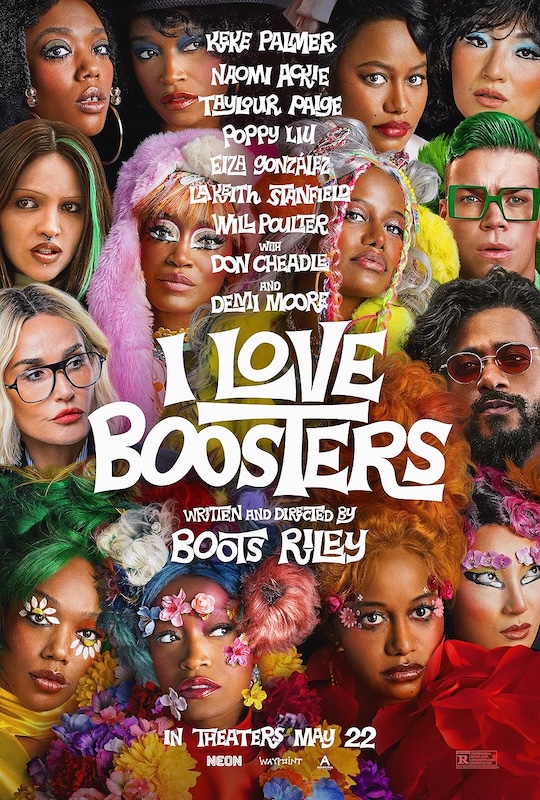
Boots Riley’s new film, I Love Boosters, is a Robin Hood story about a crew of “boosters”—people who steal high-end clothing and resell it at affordable prices to working-class people who otherwise couldn’t afford it. The result is a beautiful, playful, funny, didactic, Afro-surrealist film with an earworm score by Tune-Yards. It’s a satirical comedy packed with practical special effects. It is also an unapologetically socialist film from an openly Marxist director.
The movie takes on the cost-of-living crisis, alienation, sweatshop labor, corporate control of the media, labor exploitation at home and abroad, and the predatory self-help industry. More importantly, it is crystal clear about its proposed solution: collective action by class-conscious workers.
Set in the San Francisco Bay Area, the film follows Corvette (Keke Taylor), an aspiring fashion designer struggling to survive while living in an abandoned fried chicken restaurant. Along with her friends Sade (Naomi Ackie) and Mariah (Taylour Paige), they make up the Velvet Gang. Their primary target for boosting is Metro Designers, a fast-fashion chain specializing in monochromatic clothing. The chain is owned by Christie Smith (Demi Moore), a workaholic designer who seems to live in an especially angry TED talk.
Once Christie becomes aware that Metro Designers is being targeted, the feud turns increasingly personal. To gather intelligence, members of the gang take jobs at Metro Designers, where they witness firsthand the unfair and often illegal tactics used to exploit workers. They also meet Violeta (Eiza González), who is attempting to organize a union at the company. Soon the Velvet Gang joins forces with Jianhu (Poppy Liu), a worker at one of Christie’s Chinese garment factories with her own reasons to bring down the fashion mogul. Armed with a convenient teleportation device, the group launches an escalating campaign to empty every Metro Designers store in the Bay Area.
This is a long-overdue movie. You may have heard of Nana Duffour’s excellent 2025 short film Rainbow Girls, which also follows a group of young femme shoplifters in the Bay Area. These two films were conceived and produced entirely independently. As Duffour wrote, “What I’ve come to understand is that when two filmmakers independently look at the hyper-gentrification of the Bay Area, the crushing weight of late-stage capitalism, and the rebellious art of boosting luxury goods, and decide to make a movie about it—that’s not a case of copycats. That is a cultural distress signal. It means a story is begging to be told.”
One of I Love Boosters‘s most striking qualities is its overwhelmingly woman-led cast. While several men play memorable supporting roles—LaKeith Stanfield is particularly entertaining as Pinky Ring Guy, a literal sex demon—they are all in supporting roles. In fact, I Love Boosters joins a very small club that passes the reverse Bechdel Test: in the handful of scenes in which two men speak to each other, they only talk about women—or the women’s revenge scheme. This represents a notable and welcome shift from Riley’s previous film, Sorry to Bother You, which only has two named female characters, who do not speak to each other at all.
Spoiler alert
I Love Boosters is a surreal film with a flamboyant visual style and an abundance of wild ideas, though it is not unique in that regard. Films such as Everything Everywhere All at Once similarly combine absurdity with a flamboyant fashion sense (they both share the same costume designer, Shirley Kurata).
What makes I Love Boosters distinctive is the clarity of its class politics.Throughout the film, Christie Smith is revealed to be the real thief. She steals design ideas from aspiring artists, as well as wages and dignity from her retail employees through exploitative labor practices, and profits from starvation wages paid to workers in her overseas factories. When she is informed that the chemicals used to sandblast her designer jeans are causing lung cancer among factory workers—including Jianhu’s family—her response is indignant rage at being bothered.
The film’s final act offers a direct answer to these injustices: unionization, mass strikes, and the overthrow of capitalism. It turns out that the teleportation device that allows Jianhu to travel between China and Oakland has two additional settings. One, “Deconstruction,” can reduce concrete walls to piles of stone. The other, “Situation Acceleration,” intensifies contradictions in a distinctly dialectical manner. When amplified and combined with the teleportation function, the device triggers a worldwide surge in class consciousness. As the film ends we learn that revolutionary movements are spreading around the world.
This film is not perfect. There is a lot going on in this movie, which can make the plot feel overstuffed and rushed, especially the second act. Most of the practical effects feel fresh and vibrant in a way that CGI cannot replicate (see Mad Max: Fury Road for other examples of this). But the extended claymation sequence is a bit jarring and does not match the visual style of the rest of the movie, much as I enjoyed it.
Make sure to watch through the end credits for an explanation of dialectics from a stoner union organizer set in a hair salon. And if you haven’t seen Sorry to Bother You or Riley’s Hulu series I’m a Virgo, then add them to your list. They should be required watching for any political activist.
Opinions expressed in signed articles do not necessarily represent the views of the editors or the Tempest Collective. For more information, see “About Tempest Collective.”
Featured Image credit: Señor Codo; modified by Tempest.
We want to hear what you think. Contact us at editors@tempestmag.org.
Glenn Allen View All
Glenn Allen is a long-time political activist in Chicago.