
Can shattering capitalist economic theory lead to revolution?
A review of Clara Mattei’s Escape from Capitalism: An Intervention
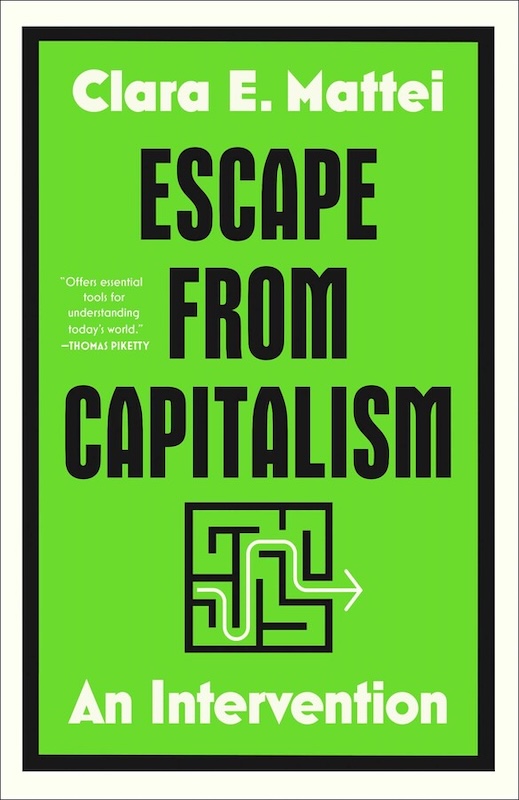
Escape From Capitalism
An Intervention
by Clara E. Mattei
Simon and Schuster, 2026

The intriguing subtitle of Clara E. Mattei’s Escape from Capitalism: An Intervention suggests that the author has some fresh observation or insight to add to existing analyses of movements that have threatened capitalism’s existence. A Marxist reader of the book might expect, perhaps, that Mattei intends to complement (or correct?) the summary and analysis offered by Colin Barker in the last chapter of Revolutionary Rehearsals, in which he discusses the conditions, commonalities, and potential of the five monumental workers’ struggles covered in that volume.
Mattei, an economist currently working at the University of Tulsa, does, in fact, describe what she sees as the path towards ending capitalism, although it comes in the last ten pages of the book (more on this below). The rest of the book consists primarily of a critique of capitalism, along with a particular thesis about the role of economists and economic theory in maintaining what she calls the “capital order.” That thesis, in turn, motivates the prescription she eventually offers.
Most of the critique of capitalism Mattei presents – and even much of her discussion of mainstream economic theory – is basic to Marxism. One is tempted, therefore, to view it as a sort of primer, written for those just beginning to consider that a different economic order is necessary and possible. Here is how she herself describes her audience (p. 14):
This book is for all those who wake up in the morning with a sense of profound dissatisfaction. I intend to challenge the fatalist notion that nothing can change and the individualist notion that it is all our fault, or the fault of those weaker than us. Instead, I want to clarify that classist economic decisions are the basis of the major problems afflicting our time. I want to clarify the mechanisms that oppress us and identify the freedoms for which we must fight.
Portions of this book might work well as an introduction to anti-capitalist discourse. But her ideas (non-Marxist, as I read them) regarding economics and the primacy of economic ideas in maintaining capitalism—and certainly her concluding prescription—require separate analysis.
Mattei walks us through several basic tenets of socialist thinking: Capitalism is a historically specific system, quite new in human history; it came into being via violent processes, often supported by states, that led to complete dependency on market exchange for human survival; it is a class-based system in which political power is relatively autonomous from economic power; its “freedom”—the freedom of the marketplace—contrasts with the unfreedom of the workplace; its dynamics lead to outrageous, continually reproduced inequalities (both within nations and between “developed” and “underdeveloped” ones); and its tendency to increase productivity comes at the cost of bouts of unemployment for workers.
Her characterization of neoclassical economic theory is also quite standard: Beginning in the late nineteenth century, economists presented their science as a “natural” one based on allegedly eternal characteristics of human behavior and capable of being applied with the mathematical precision of the physical sciences. Those economists quite consciously saw their project as countering Marxist and other class-based theories of the capitalist economy, as well as providing a basis for what eventually became macroeconomic management of it. What is non-standard in Mattei’s discussion, though, is how she uses the term “political”: She applies it to the power that capitalists have to make economic decisions regarding investment and production, as well as to the more formal political power that governments and central banks have to influence the economy. It is in this sense that she presents mainstream economic theory as “depoliticized”: The theory ignores the power of capitalists to manage production and influence market prices.
Economics itself, on the other hand, is (as Mattei announces in the title of her introduction) “a political act.” She begins by discussing the world’s first international economic conference, organized by the League of Nations in the aftermath of World War I. Concerned about the militant and often revolutionary workers’ movements of that period and fearing the destabilizing consequences of mounting worldwide inflation, the assembled industrialists, financiers, politicians, and economists resolved to implement austerity measures. In order to force the entitled and morally deficient workers to “work hard, live hard, save hard” (in the words of one of the English delegates), they argued, social welfare spending should be slashed.
Mattei traces the origins of the use of economic theory to support austerity policies to this historical episode. The starkest applications of these policies are in cases where authoritarian governments assumed power in the wake of militant workers’ movements or other systemic threats to capitalism.
Benito Mussolini’s fascism is the classic—and primordial—case. Italy’s postwar “Red Biennium,” characterized by factory occupations and increasingly political workers’ councils, had to be ended. Weakening the workers’ movement by both physical violence and austerity measures—cutting social welfare spending, raising interest rates, and shifting tax burdens from capitalists to workers—was exactly what the fascist regime implemented. In Mattei’s telling, economists played a central role. Maffeo Pantaleoni, a founder of neoclassical economic theory, had become a fascist, as had his protege Alberto De Stefani, and they along with two liberal economists became a sort of brain trust to Mussolini.
The case Mattei makes linking the new “pure economics” of mathematical equations to austerity and even violently authoritarian policies is a strong one. Her first book, The Capital Order: How Economists Invented Austerity and Paved the Way for Fascism is primarily an exploration of this point. (See David McNally’s interview with Mattei in Spectre). In Escape from Capitalism, she quotes Luigi Einaudi, one of the liberal economists who eventually advised Mussolini and who later became the first president of the post-Mussolini republic (p. 58):
When the worst happened … and the occupation of factories by armed workers and the institution of Soviets in factories seemed to point to an imminent communist revolution in Italy … [y]ouths of the middle class indignantly grouped themselves into “fasci”. … The communists are everywhere defeated … This renewed feeling of hope in the future of our country is not the least important cause of the better tone in foreign exchanges.
The glowing praise these economists afford to the National Fascist Party is matched by their reverence for the new, “objective” economic theory: “a nucleus of doctrines that are independent of opinions, as well as of ethical, political and religious predilections. Something akin to physics and mathematics.” And Mattei herself, referring to the austerity prescribed by the international conferences shortly preceding the advent of fascism, characterizes what she considers a pivotal moment in the relation between this young theory and state policy:
The experts … knew for sure … that the logic of capitalism would not recover without forceful intervention by the state, which would weaken the workers by transferring resources from the many to the few. Here lies the quintessential achievement of macroeconomics as it has long been practiced, modifying and disciplining citizens’ behavior by fiscal and monetary policy. (p. 56)
Elsewhere Mattei discusses other instances when economists have advised authoritarian regimes, for example,the “Chicago boys” sent by the U.S. State Department to work with Augusto Pinochet in Chile and the international economists who prescribed “shock therapy” for Boris Yeltsin’s post-Soviet Russian government. She also reminds us that economically prescribed austerity is not limited to such regimes. The U.S. Federal Reserve uses interest rates—sometimes in an extreme way as in the “Volcker Shock” of 1979—to tame inflation by causing unemployment and reducing workers’ purchasing power. Fed and Treasury officials (she mentions Janet Yellen and Jerome Powell) sometimes say the “quiet part” out loud by announcing that “pain” is necessary to reduce inflation.
A case can be made that austerity in some form is an essential and permanent feature of capitalism, depending on one’s definition of austerity. But I think Mattei overstates her contention that capitalism’s need for austerity is the primary driver of mainstream economic thinking. Is it right to view “transferring resources from the many to the few” as the “quintessential achievement of macroeconomics” that enables the “logic of capitalism” to recover? Redistributive policies in particular – transfers from rich to poor – (always limited in scope and time, as Mattei correctly argues) are sometimes prescribed (in order to increase demand) by the same macroeconomics profession that in other circumstances recommends austerity. And certainly the vast infusions of capital by the state that we witnessed after the 2008 crash (in this case “bailing out” financial institutions to avert catastrophic collapse) must be considered as a significant macroeconomic achievement.
Part of Mattei’s central thesis seems to be that mainstream economic theory was developed for the purpose of weakening the working class, and that economists have played a leading role in attacks by the state on labor. I think this both overstates the role of theory and presents its application in too crude a form. But she even goes further, and attributes to economists the creation of an ideological misapprehension of the world that grips everyone living under capitalism.
She is surely correct in saying that mainstream theory obscures class distinctions and mystifies the functioning of a capitalist economy. It also, as she argues, puts a veneer of objectivity and inevitability behind policy prescriptions. But her “intervention” regarding the elimination of capitalism appears to consist of the claim that academic economic theory creates an ideological barrier that impedes anticapitalist initiatives, along with suggestions for how to breach that barrier.
As with other aspects of her argument, she indicates right away in the introduction where she will be going:
I wrote this book to expose how that dominant message [of academic economics] blinds us to alternative economies. … By hiding the true nature of the economic system, they atrophy our minds, blocking any possibility of transformative action. But it is possible to escape from capitalism. (p. 11)
And a bit further on:
We must re-democratize the economy… That is a better way forward than anything capitalism has or can offer. What is the first step in this direction? It is a radical change of perspective. Only if we learn to look at the world differently can we act differently… The time is ripe to turn towards a truly modern study of economics built from the works of classical political economy. (p. 13)
In these passages Mattei appears to suggest that those looking for alternatives to capitalism need first to go through a process of rejecting mainstream economic theory. For the moment, we can put aside the question of whom she considers to be the subject, or agent, of economic change. (Who are the “we” who need to think differently: intellectuals? workers? everybody?) We can also ignore the fact that socialists have studied “the works of classical political economy” and attempted to apply them in new conditions for over 150 years, and overlook what it means to “re-democratize” an economy which has at no time since hunter-gather societies been democratic. Let us simply examine Mattei’s prescription for “escaping” capitalism in its own terms.
The route by which we can end capitalism, according to Mattei, becomes fully clear in the book’s last chapter, entitled “Democracy is Anti-Capitalism.” Most of what she has to say in that chapter regarding the limits of democracy under capitalism is, again, quite standard. One could quibble with the fact that she claims capitalism limits democracy to electoralism: She ignores liberal (or “bourgeois”) democratic rights (like freedom of speech) and legally granted rights like the right to form unions, etc., though of course those rights have definite limits.
Perhaps the last ten pages of the book, though, which contain her prescription for the escape route, should have been put into a separate chapter. Here she first reprises what she has said in the introduction:
The first step toward change is to lay bare that what counts as a social failure is not at all a failure for the logic of capital. To fight this inhumane logic that organizes our society, we must abandon the mystifying language of neoclassical economics in favor of a simple but profound explanation of our economic system, which can shake our beliefs and spur us into action…. What would happen if the majority of the people realized that in the last three years, about two-thirds of the wealth created has gone into the hands of 1 percent of the global population? (p. 107)
Is she really arguing here that it is primarily “the mystifying language of neoclassical economics” that holds back workers and others in struggling to meet their needs? Do “the majority of the people” view the world as presented in an Econ 101 textbook? The majority already believe that wealth increases most among the already wealthy! If realizing the errors of capitalist macroeconomics could itself “spur us into action,” revolutionary movements would long since have become common.
Let her continue:
I am often pressed with the question “So what do you suggest? Revolution?”. In our imagination, the term “revolution” is associated with something bloody, barbaric, and wrong. But it shouldn’t have to be…Each of us can take steps to politicize our lives. And by “politicize” I mean participate in the transformation of the material and social reality around us. The steps can be as small as connecting with your neighbors to build community. (pp. 108-109)
The Marxist notion of revolution and its centering of working-class agency don’t seem to play a role here. But Mattei does offer examples of what she means by the transformation of reality: Students can organize against their institution’s investment in corporations that profit from human rights violations; citizens can vote against and protest cuts to public welfare spending; they can also pressure politicians to raise taxes on the rich. None of these, though, create a society “that is based on different principles.” For that, people have to begin to organize production collectively.
Mattei tells us that the world is “brimming” with such organizations, and proceeds to discuss some of them. She mentions an agroecological commune outside of Sao Paolo, Brazil and its connection to Brazil’s landless workers movement (MST), whose democratic structure she emphasizes. This collective management of rural production by the direct producers is complemented by urban factory production; she cites fifty self-managed factories in Brazil and another four hundred in Argentina. “The idea that private capital is essential for production and investment is a myth. …Alternatives to private investment are real, from collective ownership by workers to public investment.”
It appears, then, that the society Mattei hopes we can escape to is one consisting of worker co-ops and state-funded infrastructure. This of course is no new model; various versions of “market socialism” have advanced similar prescriptions. All of these, though, and particularly ones that envision the achievement of full social change by means of incremental steps, fail to consider that market dependence makes the same demands (to increase productivity, undercut the competition, and attract new financial resources) that capitalism does. If it were possible to put such models into practice, they would, in short order, reproduce capitalism.
A real assault on capitalist power requires certain conditions that cannot simply be brought about by growing numbers of individuals freeing their minds from the straitjacket of neoclassical economics and taking steps towards collective action. Among the indicators that such conditions exist, to be sure, is the organization of production and distribution by workers themselves. But the existence of worker co-ops in the context of a capitalist economy is not itself an indicator of potentially revolutionary conditions.
Such conditions have in fact existed in the last century, sometimes in individual countries (France 1968, Portugal 1974, etc.) and once in an entire continent: Europe after the first world war. Earlier in the book, Mattei discusses this period, mentioning events in Germany, Hungary and Britain before going into more detail regarding Italy’s “Red Biennium.” While she points out the massive extent of the movement for “popular self-government,” and does mention Turin’s workers’ councils and their democratic structure, she spends more time on the role of politicians and socialist intellectuals. Here she highlights the role of Antonio Gramsci and his comrades writing in L’Ordine Nuovo. That publication chronicled, and reflected on, the factory councils that had begun to control and organize production democratically.
Mattei comments on the interplay between workers’ self-activity and the intellectual reflections which led to new theoretical conclusions and suggestions about what would be necessary to reconstitute society: “L’Ordine Nuovo contributed to the deep conviction that no true social revolution is possible without a revolution in the way we understand society. Gramsci named this mutually reinforcing connection between theory and collective action ‘praxis’” (p. 54).
This formulation implies, as Mattei does elsewhere, that liberatory ideas have to precede liberatory activity. But further down the same page she writes:
Gramsci and his comrades now understood that emancipatory knowledge had to emerge from collective organizing in the workplace and could thus support action from the bottom up. As “absolutely original institutions” of the proletariat, the councils functioned as nuclei of a new state.
The first sentence of this passage can be read as generally consistent with her discussion at the end of the book, apparently identifying the transition away from capitalism with the proliferation of worker cooperatives and increased state participation in the economy.
But the second sentence provides a stark contrast, especially in its reference to a new state form. In her closing discussion, Mattei refers to Mexican President Claudia Sheinbaum’s public housing initiatives and Mexico City Mayor Clara Brugada’s construction of community centers as examples proving that private capital is dispensible. Clearly, she is referring here to the existing state apparatus, and indicates no need for that capitalist state to be replaced by something else.
This seems in contradiction with a discussion earlier in this final chapter, quoting Ralph Miliband’s The State in Capitalist Society, and pointing out that political parties participating in government act to uphold capitalism, even when they oppose the interests of particular capitalists. She does not seem to recognize, let alone attempt to resolve, this contradiction. One wonders whether she has considered the difference between the European workers’ councils of 1917-1922 and the contemporary South American cooperatives she has mentioned.
In the end we are left wondering whether Mattei believes that the kind of movement exemplified by the early 20th century workers’ councils is necessary to bring capitalism to an end, or whether, perhaps, they only represented the requirements of an earlier era. Indeed, from what she says in this volume, it would appear that we do not now need much investigation or analysis of social movements and their history in order to develop the ideas we need.
I do think, though, that a book covering some of the same material, perhaps equally as short and written for a newly radicalizing audience, would be useful. I’m not sure if a book of this nature about the Europe-wide workers’ movement after World War I exists – something along the lines of China Mieville’s October (about the Russian Revolution) and much shorter than Pierre Broue’s brilliant, 900-page The German Revolution, 1917-1923. Given Mattei’s argument about the usefulness of unemployment for capitalism in weakening labor, perhaps a historical survey and statistical analysis – again, for a popular audience – correlating high unemployment with a weak labor movement and low unemployment with a strong one would be another useful contribution.
Mattei’s own earlier work The Capital Order, linking economic theory with fascism, is itself such a book. Perhaps we can expect another from her.
The author would like to thank Charles Post and Sam Salour for very helpful conversations and comments on a draft of this review.
Opinions expressed in signed articles do not necessarily represent the views of the editors or the Tempest Collective. For more information, see “About Tempest Collective.”
We want to hear what you think. Contact us at editors@tempestmag.org.
Mel Bienenfeld View All
Mel Beinenfeld is a member of the Tempest Collective in New York City.