
The Iran war comes home to India
LPG, the general strike, and the working class

It began, as so many crises in India do, in the kitchen.
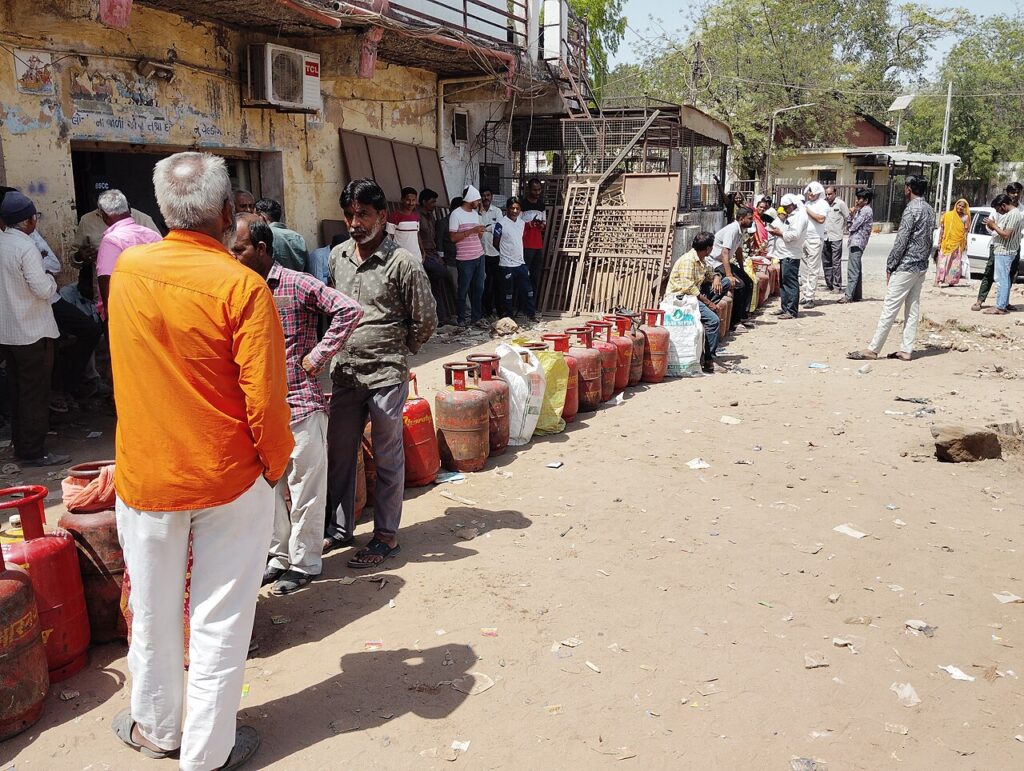
By the third week of LPG (liquified petroleum gas) disruption—triggered by the war on Iran and the effective closure of the Strait of Hormuz—long lines had become a national spectacle. Women woke before dawn to wait for gas cylinders that might not arrive. Families who had only recently abandoned the chulha—wood-burning stoves associated with poverty, smoke inhalation, and unpaid labor—dragged it back into use, collecting scrap wood and burning crop residue again. A decade of incremental transformation promised by the Pradhan Mantri Ujjwala Yojana (a program providing free gas cylinders to poor women) unraveled in weeks.
When LPG disappears, women absorb the shock first. Hours once freed for wage labor, education, or rest return to fuel collection and cooking. Economists describe this as “time poverty,” but the phrase obscures what is actually occurring: Crisis is redistributed downward through social reproduction long before it appears in macroeconomic indicators.
War reorganizes everyday life unevenly. Its earliest effects are registered not in diplomatic communiqués but in altered routines—kitchens, fields, and workplaces where geopolitical decisions become lived constraints.
The present crisis is therefore not simply the domestic fallout of a distant war. It exposes the structural fragility produced by three decades of neoliberal restructuring, in which labor was fragmented, the country’s dependence on energy exports was externalized, and economic growth made dependent on imperial supply chains. The LPG shortage does not interrupt this model. It reveals it.
The shock arrives
The escalation began in early March 2026 following American and Israeli strikes on Iran. Tehran’s effective closure of the Strait of Hormuz disrupted a chokepoint through which nearly 90 percent of India’s LPG imports normally pass. War-risk insurance collapsed, Gulf exporters declared force majeure—which allows them to renege on contracts to deliver oil and gas due to “acts of God” or war—and weekly LPG inflows into India fell by roughly 30 percent.
LPG is infrastructural rather than optional. By 2025, approximately 329 million households depended on it. The Ujjwala scheme extended subsidized access to over 103 million of the poorest families—precisely those least able to absorb supply shocks.
Scarcity therefore produced regression rather than adaptation. Middle-class households substituted fuels. Working-class households reverted to older survival strategies.
Administrative responses followed familiar lines: anti-hoarding raids, rationing, and industrial gas cuts. Restaurants closed, fertilizer output slowed, and inflation spread outward from energy markets into everyday consumption. The crisis connected ports, farms, and kitchens into a single chain of vulnerability.
The strike that came before
The decisive fact about the LPG crisis is chronological: The Indian working class was already mobilizing before the war began.
On February 12, 2026—sixteen days before escalation—a nationwide general strike organized by the Joint Platform of Central Trade Unions mobilized workers across more than six hundred districts. Participation spanned public-sector workers, construction laborers, pre-natal and post-natal care workers, street vendors, and home-based workers.
The strike’s significance lies not in immediate concessions but in what it reveals historically. The present situation marks the exhaustion of the labor settlement forged after liberalization in 1991—a settlement premised on growth without bargaining power, informalization without political incorporation, and welfare expansion without structural redistribution.
The contrast with the 1974 railway strike illustrates the change. That confrontation emerged within a developmental state compelled to negotiate with organized industrial labor capable of halting national circulation. Workers exercised concentrated structural power.

Post-1991 restructuring dismantled those conditions. Employment fragmented, public-sector union density declined, and production dispersed across informal, unregulated networks. Labor expanded socially even as its bargaining leverage weakened institutionally.
Today’s general strikes therefore embody a paradox: massive participation alongside limited coercive capacity. They function less as negotiations than as periodic demonstrations of collective existence—signals of distress rather than mechanisms of victory.
The LPG crisis clarifies this transformation. Workers protested declining wages and labor-law consolidation before the war; the energy shock merely translated structural precarity into household crisis. What appears as sudden disruption is in fact the delayed manifestation of neoliberal restructuring.
The thesis of the present moment is therefore straightforward: The war did not produce instability in India’s working-class life. It exposed the instability already built into the post-1991 order.
Coalition fragility and regional political stress
The crisis arrives amid unprecedented political fragility for the ruling BJP following its reduced mandate in the 2024 Lok Sabha (legislative) elections. Governing now depends on coalition partners whose regional economies are directly exposed to external shocks.
These tensions are visible most clearly at the level of India’s states.
In West Bengal, the approaching assembly election has intensified competition between the Trinamool Congress and a BJP seeking to recover ground lost after its earlier expansion stalled. Rising fuel costs and inflation have reshaped campaign discourse, allowing Trinamool’s Mamata Banerjee to frame the LPG crisis as evidence that Delhi’s foreign-policy ambitions impose material costs on the states and territories. The BJP, unable to disown national policy, increasingly relies on polarization rather than economic messaging—a sign of defensive rather than expansionary politics.
In Tamil Nadu, the DMK government under M.K. Stalin has used the crisis to revive a long-standing Dravidian critique of centralized economic decision-making. Tamil Nadu’s manufacturing-heavy economy—deeply integrated into global supply chains—faces rising input costs and export uncertainty. State leadership has emphasized federal fiscal autonomy and social welfare buffering, contrasting regional governance with what it portrays as northern majoritarian economic mismanagement. The result is not separatism but renewed subnational assertion within an already strained federal structure.
Meanwhile, the BJP’s coalition partners face their own pressures: The remittance-dependent economy in the state of Andhra Pradesh suffers from Gulf instability, while Bihar’s high Ujjwala penetration means shortages strike directly at households incorporated into the BJP’s welfare coalition.
Opposition parties identify political opportunity but avoid naming structural causes, since liberalization itself remains bipartisan consensus. The crisis therefore destabilizes electoral alignments without yet producing ideological realignment.
Growth statistics and the politics of revision
The energy shock also exposes a quieter instability: the persistent downward revision of India’s economic narrative.
Since the 2015 GDP methodological overhaul, growth estimates have been repeatedly revised—often substantially—months or years after initial celebration. Quarterly growth figures announced with optimism have been corrected downward as new data emerges. Industrial output estimates fluctuate sharply between advance and final calculations. Employment surveys appear, disappear, and reappear with altered baselines.
This pattern is not merely technical. Statistical revision has become a political process through which optimism is announced early and reality acknowledged later.
High-frequency indicators—electricity consumption, credit demand, export performance, and rural wage growth—have consistently suggested weaker underlying expansion than headline GDP implied. Private consumption growth has slowed, investment rates remain uneven, and real wage growth for informal workers has stagnated despite aggregate expansion claims.
The constant recalibration produces an economy that appears strong in projection but fragile in practice. When the LPG shock arrived, there was no buffer because the growth model never generated one.
The queue outside the gas distributor therefore contradicts the statistical narrative not symbolically but empirically.
Sub-imperial alignment
India’s position in the global order is best understood as sub-imperial: pursuing regional ambitions within U.S. strategic architecture. Projects such as the India-Middle East-Europe Economic Corridor institutionalize this alignment.
“Strategic autonomy” increasingly means negotiated dependency. Temporary access to discounted energy coexists with long-term geopolitical alignment that limits policy independence.
Domestically, Hindutva nationalism stabilizes this arrangement by fragmenting class solidarity, converting economic grievance into cultural antagonism.
Pakistan’s mediation and regional escalation
Pakistan’s emergence as mediator between Iran and the United States has been celebrated internationally as stabilizing diplomacy. Within South Asia, it intensifies rivalry.
Mediation restores Pakistan’s geopolitical relevance amid economic crisis, challenging India’s claim to singular regional partnership with Washington. Indian political discourse reframes mediation as strategic encirclement, while Pakistani elites present it as diplomatic resurgence.
External de-escalation thus generates internal competition. Both states translate diplomatic positioning into nationalist legitimacy, justifying military expenditure and narrowing political debate.
Workers confronting parallel crises are encouraged to perceive one another as adversaries rather than participants in shared structures of dependency—a familiar outcome of postcolonial state rivalry embedded within imperial hierarchy.
Toward a working-class anti-imperialism
The parliamentary Left’s appeal to defend “national interests” repeats a recurring mistake: assuming national alignment will resolve class contradiction. Even geopolitical independence would not automatically undo neoliberal restructuring.
Independent labor movements in Iran suggest another path, opposing both external aggression and domestic authoritarianism while grounding politics in working-class autonomy.
What the present situation demands is a politics capable of linking the LPG queue, the Labour Codes, fertilizer scarcity, remittance instability, and imperial alignment into a single analytical frame.
The woman waiting before sunrise did not choose this vulnerability. It emerged from decades of decisions integrating India into a global order whose gains accumulated upward while risks settled downward.
The stacked firewood beside an empty cylinder is therefore not only evidence of shortage. It is a historical archive—neoliberal restructuring rendered visible in everyday life.
Making that connection visible is the beginning of a socialist politics adequate to the crises now unfolding.
Researched and composed by the author, with some editing assistance from Copilot.
Opinions expressed in signed articles do not necessarily represent the views of the editors or the Tempest Collective. For more information, see “About Tempest Collective.”
Featured Image credit: Farah Diba-Pahlavi and Ministry of External Affairs, Government of India; modified by Tempest.

Categories
We want to hear what you think. Contact us at editors@tempestmag.org. And if you've enjoyed what you've read, please consider donating to support our work:
DonateSnehal Shingavi View All
Snehal Shingavi is associate professor of English at the University of Texas, Austin, where he specializes in the teaching of literature in English, Hindi, and Urdu. He is the author of The Mahatma Misunderstood: the politics and forms of literary nationalism in India (Anthem Books, 2013). He has translated Munshi Premchand’s Hindi novel, Sevasadan (Oxford, 2005), the Urdu short-story collection, Angaaray (Penguin, 2014), Bhisham Sahni’s autobiography, Today’s Pasts (Penguin, 2015), with Vasudha Dalmia, Agyeya’s Shekhar: A Life (Penguin 2018), and Joginder Paul’s A Single Drop of Blood (Penguin 2020). His translation of Yashpal’s novella, Geeta: A Party Comrade, is forthcoming. He is also a long time social justice campaigner and organizer.