
Communism, abolition, states, and the future of the Left

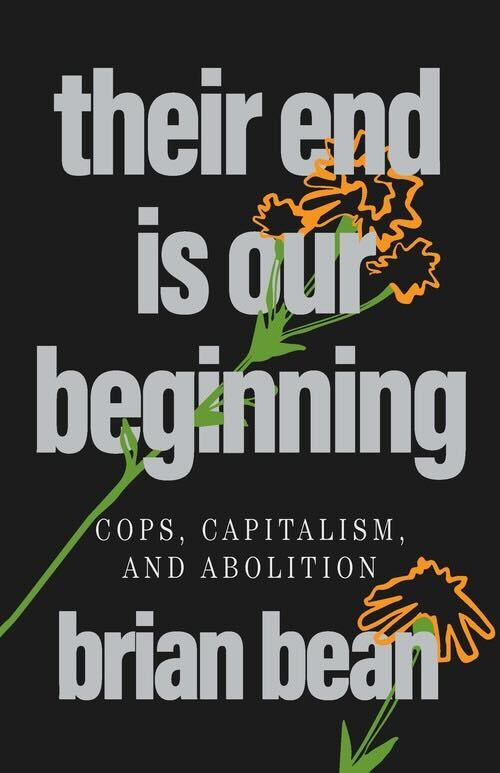
Their End Is Our Beginning: Cops, Capitalism, and Abolition
by brian bean
Haymarket, 2025

Red Flags: A Reckoning with Communism and the Future of the Left
by David Camfield
Fernwood Publishing, 2025
Demetrius Noble: Good evening. Welcome to the Haymarket Books discussion of communism, abolition, and the Left featuring authors and comrades David Camfield and brian bean. I’m Demetrius Noble, and I will moderate tonight’s discussion on their respective books. I’m really excited to discuss David’s book Red Flags and brian’s book Their End is Our Beginning.
To open things up, a primary theme that is explored in both books is the leftist critique of the state. More specifically, it seems that you are both very much interested in having us, and by us I mean the Left broadly, assess our orientation to the state and how it informs how we struggle for change.
What should our orientation to the state be right now, as we currently assess where we are and what is needed to organize and struggle for the types of revolutionary projects and goals outlined in your respective books?
brian bean: I’ll start by talking about that big question about the state. And I think it’s funny to just talk about that because sometimes in doing the day-to-day work of building movements and engaging in social struggle, the question of the state can seem like an abstract one. At other times, it can be overwhelmingly crucial. Like right now, I’m thinking about what one does with elections, for example, Mamdani’s win in the New York City mayoral race. Or, for example, when you have ICE agents kidnapping people off the street, like they are in Chicago right now.
But to step back, what do we mean by conception of the state and what are the ramifications of that? I think the first thing to understand is that the state is not class-neutral. It’s not something that can just be transformed by working-class people or the oppressed. The state’s very existence is to create a good business climate in the interest of the system of capitalism. So, the state is the preferred model for capitalism as opposed to direct rule by individual capitalists.
This is unlike times in the past in pre-capitalist societies, where they were often ruled by one individual king, a dynasty, or the like. Under capitalism, the capitalist class, all the billionaires and so on, are in solid solidarity against our interests. But capitalists are also in competition with each other.
Individual capitalists are not good at administering what is best for the system as a whole because their individual profits always dictate their interest. So Jeff Bezos can’t really determine what is best for the system of capitalism because he’s really invested, and I use that word intentionally, in maximizing his own profit.
So capitalism needs a body that has a relative separateness from society. This is what Marx talks about as far as a committee of the general interests of the bourgeoisie. That’s what the state is. And that body that has this relative separateness has to be able to enact its will, administer taxes, and set and enforce laws.
And those things, of course, are almost always done against us–the working class, the oppressed, the dispossessed–but occasionally the state acts against individual capitalists. So it’s a capitalist state because it runs on tax revenues and then requires investment. The state administers political choices whose horizon is set by what is best for the general business climate of the system of capitalism. That is why it’s a capitalist state.
But what allows it to do these things is the police. So behind the force of every law, as innocuous as “pay your taxes” or “don’t sleep here” or “get off the street” or “don’t do this,” is the threat of violence.
It is the threat of the police officer’s baton and the gun that allows the system to continue to move as it does to churn out profit for the ultra-rich and the billionaires. This is why Lenin, the Russian revolutionary, described the state as a special body of armed men. That basic description still applies today, and I leave it gendered as men on purpose.
Before Trump’s administration, already 75 percent of all federal employees–be they Department of Defense, be they prisons, be they border patrol, be they the FBI or the CIA–75 percent of all federal employees constituted bodies of armed men. And these numbers have been shifted even more by Trump’s huge cuts to the administrative state, firing people in the Environmental Protection Agency,, the Department of Education, and so on. And he has overseen a hundred percent increase in the budget that is going to ICE and border patrol agents who are terrorizing our communities everyday.
So the state, at its core, is that of a special body of armed men that carries out the interests of the committee of the general capitalist class to keep the system going in all its violence and terror. And so what does this abstraction mean? In my book, I argue that it means that if we want to abolish the state, we need to get rid of the police.
We’re seeking to abolish the thing that is in many ways necessary for the state to keep functioning, to maintain its monopoly on legitimate violence. The consequences for strategy are that we will not abolish the state. We can’t abolish the police through the state as if we’re going to win electoral power and then dissolve them as an agency. But similarly, we can’t go around that state. We can’t just make up the alternatives on a community basis and assume the police will disappear or wither away.
The police will never be obsolete for the ruling class, even as much as we make them obsolete for us. So we may engage in struggle on the terrain of the state and government, trying to put the pressure on the government to do things like have mental health workers respond to mental health crises and engage even in running electoral struggles.
Similarly, we may engage in struggles on the terrain beyond the state in working to build communities that are organized to better handle conflict and work collectively to keep each other safe. But the state is not class-neutral, and the police are its main tool. This means that our task of abolishing the police has to come along with replacing the state with actual democracy, not having a body that floats above, acting against our interests, unaccountable, and with the constant and ever-present threat of police violence that secures state power.
I think this is what David gets at in his work. Any attempt to really win a society that’s democratic, in which we actually control our resources, our labor, and our destinies, will at some point come up against the police, the institution that is always used to thwart our dreams and strivings for a better world.
Practically, this means that our organizational tasks should not just be judged along the scale of whether they achieved the immediate win, the reform, or even elected office. We have to have the utmost clarity about the larger horizon of political change and see the state and the police as obstacles in building a movement powerful enough to overcome them in building a new world.
David Camfield: I really agree with everything that brian just said, and I would add that if we think about the state as part of the fabric of capitalism, it’s really part of how the dominant class rules, regardless of which political party forms a government at any particular time. It’s why it’s a capitalist state, and I think this is also important to understand.
The state has become ever more important to capitalism since the global crisis that began with the 2008-2009 recession. Capitalism has not extricated itself from the crisis that began at that time. The state is ever more involved in different kinds of ways in perpetuating the system, in trying to get it through the crisis that it still faces. And just also to pick up on something that brian said, even when you have a capitalist democracy at its best, which is not the United States today. Even if you find a historical example from another part of the world where you have capitalism with a broad welfare state and the best kind of capitalist democracy, it’s still a very undemocratic form of society because, at its best, you’re voting every four years or something like that for who is going to administer those state institutions. But you don’t vote for so many people, right?
You only elect people to the legislature and a few executive positions. You don’t elect the people who head the police. You don’t elect the people who head the central bank. You don’t elect people who are the top of all sorts of other state institutions. And we don’t vote for our employers. We don’t vote on anything connected to the places where so many of us spend so much of our time in the world of paid work.
Really, the state is about a small minority of people administering the vast majority. It’s not about the democratic self-government of the majority of people over the decisions that affect our lives. And so when it comes to strategy, I think we need to think above all about trying to build counter power: counter power to our employers and counter power to the state, whether that’s taking on Trump or taking on employers.
Of course, we need to defend what remains of the welfare state. We don’t want libraries privatized, we don’t want public transit to be privatized where it’s still public. But that doesn’t mean defending the capitalist state as it exists.
DN: As I think about what you state here, it seems like one thing that would flow from both of these types of conceptualizations is politics, socialism, abolition, and communism from below. Could you speak more about that as a kind of central and guiding framework in your respective works?
DC: Yes, it’s absolutely a politics from below. We could say socialism from below or communism from below. It’s not the words that matter, it’s the ideas. And that’s to distinguish it from a politics of change from above.
My book Red Flags looks at societies like the former USSR, China, Cuba, and others. And of course, these have been seen as the alternative to capitalism by most people around the world since they first came into existence. But we, in order to actually think about politics in the present, have to look at those societies and think about whether those are societies on the road to liberation toward the kind of society we want to create.
And what were these societies? We have to cut through the language and the rhetoric and see that these were societies where there was a central political bureaucracy of a one-party state that mobilized the labor power and the resources of society in order to carry out its project for economic and social development.
When we analyze this using the tools that Marxism gives us, we can see that in those societies, there was a ruling class that was exploiting the labor of the direct producers, in other words, workers and peasants. And these were not, therefore, societies where there was any transition going on from a society divided into classes towards communism in the proper sense of that idea of a classless and stateless society of freedom.
These were, are class societies. I think that’s the key thing. I would also argue that they were a distorted form of capitalism. But more important than that is just to recognize these were not societies that were in transition towards communism. And that means when we think about the politics that we need here and now, we need to look elsewhere than the tradition that’s associated with those societies. That’s the tradition of Marxism-Leninism. There are other traditions. I think we should look to those, because Marxism-Leninism is a form of change from above.
bb: In thinking about socialism from below, I go over a series of struggles that are not often seen as touchstones or examples in thinking about struggles against the police. And I think that it’s important to hold onto those for two reasons.
The first is because they’re international. There’s a lot of focus on the U.S., especially on the police, and the U.S. police are especially racist and especially violent. However, it is also a capitalist institution. You can get a cop to beat you up in every country in the world. And there’s a reason for that, and it has to do with the capitalist state.
In my book, I go over a series of instances in which people rose up from below and tried to carry out and enact a change on the level of society. I talk about Derry in Northern Ireland in the late sixties, early seventies, Oaxaca, Mexico, in 2006, the various uprisings of the Arab Spring in 2011, and South Africa in the late eighties. I’ll start with the Derry example. The people of Derry were suffering under British colonialism. That meant a lack of equal rights, and it also meant the stifling brutality of the police. In 1969, movements around housing and voting rights exploded with an uprising that literally pushed the police outside of the barriers of a certain area of town and created Free Derry.
And so for first a series of months and then in a second iteration for a year, the police were run off the streets, and people were able to mobilize and carry on their daily life without them. And in many ways, in better ways, people organized communal kitchens. The milk still got delivered. Conflict was managed by all types of different institutions. And so it shows that in a certain kind of struggling from below, people actively find ways to take charge of their lives in their communities.
Another iteration of this process was the Syrian revolution in 2011, part of the regional conflagration of uprisings against the kind of inequality of global capitalism, post-colonialism, and the uniquely undemocratic forms that were existing in the regimes of the region.
Many countries had these huge, massive uprisings. Syria was one of them. And in many places across Syria, people rose up and literally ran the police off the streets and began to run their communities on their own democratic basis. Local coordinating committees that organized the protests would take on various institutions of managing conflict, making sure the bread got delivered, and all those sorts of things.
Each of these instances shows how people struggle from below, not asking someone on high to do it for them, but taking charge and building movements that have a particularly antagonistic revolutionary quality. People make space to create alternatives, not by asking the government to create them, but literally by running the police off the streets and taking control of their communities, their states, and their worlds to experiment with real alternatives, to provide glimpses of what a liberated world may look like.
The capitalist states mistaken for “actually existing socialism” that David talks about are also repressive police states, just like the United States. Having an internationalist abolition approach is a “Yes, all cops” approach, which is to seek solidarity with people in China who are rising up against the police there and people in Hong Kong who are rising against the police there. We recognize our joint struggles against our various undemocratic and capitalist states. And that means rejecting the argument that we must support these despots. A true internationalist abolitionist struggle is our banner.
DN: This makes me want to pivot back to David’s argument for exploring other traditions. David, are there any other traditions that you would like to call to the fore here that we might put in conversation with some of the examples that Brian mentioned? What do you have in mind when you think of these other revolutionary traditions that we might think about in terms of models for how we move past the state as we know it?
DC: Let’s go back and say that, as long as there have been socialist or communist traditions, there have actually been contending ideas inside those traditions about how change happens and what the goal is. And one way of talking about that is to look at the “from below” and “from above” parts of the tradition.
There’s a classic essay by Hal Draper called “The Two Souls of Socialism.” It was written in the 1960s, but it’s definitely worth checking out today. It’s not the last word, but it’s an important essay. There’s a dominant version of communism or socialism that has always been about the idea that some minority can hand change down to the majority. In the 1800s, before Karl Marx broke with it, you had this idea that the masses, the working class, were not ready for freedom, not ready for communism.
And so you had to have an enlightened minority that would take power and educate them to the point where they would be ready for it. And in one version or another, that has persisted even among people who thought of themselves as Marxists, whether it was the idea that a party would take power and hand liberation down, build socialism with the support of the majority, or whether it was a guerrilla army or some other minority force that would take power.
It’s a substitute, right? And it’s always a substitute for the majority of people emancipating themselves through their own self-organized liberatory struggles. And so I think we need to go back in order to address the challenges of the present and reclaim in a critical way all that’s best in those traditions and the struggles from below.
Not all the answers to the questions of the present are going to be found in the past. But tradition is a very valuable source of ideas. And we can see in all sorts of different struggles how people are organizing themselves to fight for their own liberation. We can see insights that are generated, we can see experiences that are worth learning from, including the ones that brian mentioned, which are a great feature of his book.
DN: brian, you had mentioned that as we struggle, we have to keep in front of us the question, what is our larger horizon of political change? What is the expansive scope of our political imagination? And David, you described how some societies described as socialist were not, upon historical examination, on the road to liberation. The question I would like to posit for you to reflect on as we think about the types of struggles that are in front of us right now is, how do we engage in these struggles in a way that ensures that we’re keeping our political aspirations expansive beyond what’s immediately efficient or practical? And thatwe don’t cut off our larger kind of political vision.
bb: I think that the art of politics is about how to engage in the current moment but not lose sight of the larger horizon, while not also doing the vice versa of losing sight of the current moment and only talking about an abstraction of the horizon.
There’s a quote from Italian communist Antonio Gramsci that says that our goal is to link every demand. So every demand, from the smallest ones to the revolutionary objective. Make use of every partial struggle to teach the masses the need for general action against the reactionary rule of capital, and seek to ensure that every struggle of a limited character is prepared and led in such a way as to be able to lead to the mobilization of the proletariat and not to their dispersal.
And so I think that is our task. And I think it means speaking frankly and ensuring that we also build our organizations, not just around the immediate reforms, but around some of the political questions, and to make this maximally concrete. I think we’re seeing this contradiction a little bit with the current election of Mamdani in New York City, in which there’s a huge movement behind him that is really inspiring, really exciting.
And so I think the question is one, how do we win those things that he put forward, which are the reason for his popularity. Universal healthcare, rent caps, and free, fast buses. How do we actually win those things? We need to be a part of and fight for those demands and struggle in such a way that it is not just asking for someone to do it for us.
We can take the energy that people have for wanting those things and say, how do we build to win that? And that might mean building a force that may be critical of and maybe even antagonistic to Mamdani. We need to make sure that we are where people are at and that we’re trying to fight the best fight and arguing to do so from below.
I think that the Mamdani election is very exciting, but there are some political warning signs, particularly around the question of the police. He has endorsed some positive community safety plans that would have a lot of good for a lot of New Yorkers. This idea would take some of the activity of the police off the streets, put in mental health responders, put in special supports around transit, and other things. So that’s a positive thing.
But he also continually says, “Hey, we’re doing this to allow the police to do their job.” This reinforces the dominant ideological narrative that the police are here to keep us safe. During his campaign run, at a certain point, he had a press conference where he went on air to apologize for calling the institution of policing racist during the George Floyd uprising. And so the political task, I think, is how we fight around those things in a real non-sectarian way that has appeal to most people, but also pushes back against this kind of capitulation. Through fighting for fast and free buses, and so on, we also need to continually push back against the hegemony of propaganda that says, the police are going to keep us safe, they hold us back from chaos, and we’ll just do better policing. I think those ideas changed radically in the context of the George Floyd uprising. We shouldn’t roll that back, but figure out how to push that forward in a way that also connects with people where they are and patiently explains these problems in a clear way, pointing towards that final goal of abolition.
DC: I certainly agree with brian, and I’m also going to give a quote from the sixties, from a group of socialists in Britain who wrote that, in their words,
Meaningful action for revolutionaries is whatever increases the confidence, the autonomy, the initiative, the participation, the solidarity, the egalitarian tendencies, and the self activity of the masses, and whatever assists in their demystification. Sterile and harmful action is whatever reinforces the passivity of the masses, their apathy, their cynicism, their differentiation through hierarchy, their alienation, their reliance on others to do things for them, and the degree to which they can therefore be manipulated by others, even by those allegedly acting on their behalf.
And I think if we really take that to heart, we can apply that in really concrete ways, even when the level of social struggle is really low. The key is to avoid compartmentalizing. We don’t want to have, on the one hand, this part of our brain that says, and where maybe our heart is, which says we want a classless and stateless society of freedom, but I’m just gonna pull the lever for the Democrat over here.
There’s a disconnect. And so what we need to do is to try to apply these liberatory politics in practical ways. And I’m just going to give one example from my experience, which was 25 years ago. I was part of a strike. And at one point, we were told by the employer that if we didn’t move our picket lines off the employer’s property, they were going to call the police in against us.
A lot of union leaders would at that point have just capitulated. But the executive of our union did the right thing. They called a mass membership meeting. And in that meeting, we decided that we would call their bluff because we didn’t think that they actually wanted to have police wagons showing up and arresting strikers.
This was a university worker strike. We didn’t think they actually wanted to have all sorts of people just being peaceful picked up and carried and put in the back of vans and so on. We democratically made that decision in a mass meeting to defy what we had been told. And we kept the picket lines where they were, and we were right. They blinked.
That’s not revolutionary, but it’s applying that kind of from-below politics of democracy and self-organization that gives people the experience of actually being able to break boundaries. I think that’s the way we try to translate the long-term vision of liberation into the here and now, wherever we find ourselves, even if it’s sometimes very modest.
DN: Brian, you were talking about this kind of dance that we have to do on the Left, using the Mamdani moment as an example. He’s advancing a platform that we absolutely should rally around because these types of things will provide immediate relief to the working class. We need to champion those things, but also find ways to challenge him when he’s capitulating to the state. How do we challenge that in the most productive ways and not allow these reforms to impede our larger kind of political vision?
And for David, I want to ask about how anti-communism functions ideologically to stigmatize reform struggles like free public transportation and rent caps as dangerous communism for the masses.Could you speak more about anti-communism, how it functions ideologically in that way?
DC: Anti-communism, first of all, is not a new set of ideas. You can actually go back and see it in the 1800s when you find it used as a weapon against the Paris Commune, when the workers of Paris rose up in 1871 and took control of their city, for example. But the basic message of anti-communism is that any attempt to try to transform society, to replace capitalism with something else, is going to lead to some absolutely terrible, authoritarian, repressive nightmare.
All sorts of both real and fictitious examples from history are then brought forward to bolster this case. And I say both real and fictitious because there are all sorts of things in anti-communist literature and documentaries that are just outright lies, about conditions in Cuba or Venezuela or what have you.
But then there are sorts of actual experiences of oppression and exploitation and repression in those societies that I mentioned, and in many others. The USSR and other societies organized along those lines get wheeled out for anti-communism, but the whole discussion has become confused.
By the way, Trump and MAGA just accuse anyone they don’t agree with, any kind of Democrat, often of being communists. But then you have Kamala Harris saying that Trump was a communist dictator, right? Further confusing the whole discussion, and there’s just an incredible amount of confusion to cut through.
Communism just ends up being used as just a slur about bad things. “We think this is awful. We’re going to demonize it, call it communist.” We have to try to cut through that to recognize that it’s an ideology of obfuscation. That it’s being wielded to defend capitalism, to defend the status quo, whether that’s defending the version of the status quo that Trump wants, or, the version of the status quo that his Democratic party opponents want.
Then there’s the question of how we oppose anti-communism. We absolutely have to challenge anti-communism. We need to actually learn some of the history so that we can do this most effectively and be able to see what’s being argued.
But I think the most common way when people figure out what’s going on with anti-communism is they just say, okay, this is an ideology that defends capitalism. And they reject it, but at the same time, they’re either sympathetic or sometimes actually more positive to societies like the former Soviet Union. And they just take where the anti-communist puts a minus sign, and they flip it and put a plus sign instead of thinking critically and actually analyzing those societies.
There’s a different approach, a different way of rejecting anti-communism. There’s a great slogan from the sixties in Britain that encapsulates this: “The ‘Communist’ world is not communist and the ’Free’ world’ is not free.”
And I think that’s the way that we should reject anti-communism. We’re rejecting the idea that we live in the best of all possible worlds, that we live in some wonderful land of freedom and democracy, but we also reject the idea that those societies, including, for example, Cuba and China today, that those societies would actually be communist or on the road to communism.
DN: When you think about anti-communism as an ideology of obfuscation. I really like that language. Brian, you remind us just how murderously and dangerously violent capitalism is, like right here, right now. I think you have a quote in your book about random murders. I think you said one in three is actually done by the police. Can you speak more about just this in terms of the monopoly on legitimate violence, how dangerous and deadly the police are, and how anti-communism works as an ideology of obfuscation?
bb: The quote you’re referring to is a statistic that I have in my book about the violence of the police that complicates the common thought of how murders are committed. A large majority of murders are committed by people who know the victim, but if you are killed by a stranger, there is a one in three chance it is a cop. I think there’s such a symmetry between some of the mythologies around anti-communism and around talking about the police.
And that symmetry is that, “Hey, if people try to take control of their world it is always going to turn into an authoritarian despotic state.” The assumption is that ordinary people actually can’t protect their communities themselves and be in control of their destinies.
And those same mythologies are the same ones that are trotted out around the police. If we don’t have the police, there’ll be chaos. If we don’t have the police, it’s going to be like that movie, The Purge, random violence happening around every corner. I think that’s a really pernicious obfuscatory myth. You can find many examples of uprisings in which people push back the police and try to reopen society. There was a police strike [in 1976] for weeks in Finland, and the society did not devolve into chaos.
In the U.S., police often go on slowdowns during which they only carry out “necessary arrests,” which is really funny if you break that down. I think they are very conscious that there are arrests that are unnecessary as part of their daily practice, but that’s another story.
So, during these slowdowns, they found that when the police were doing less, actual reports of crime dropped. So, fewer crimes were occurring. A couple of years ago, in the Bronzeville neighborhood in New York City, there was a five-day period during which they intentionally removed the police and put social service agencies on call as an experiment. This is a neighborhood that’s had a high incidence of police calls. And during that period of time, when the police were gone, and social supports were present. There was only one 9-1-1 call that was done accidentally by a truck driver or something like that.
In Chicago, we had a surveillance program called Shot Spotter that had sensors that would perceive gunfire and direct police to it. It was a horrible surveillance device, and it didn’t work.
And so they removed them. Gun violence went down. Contrary to the mythology that you remove the police and there’s chaos and violence, the converse is actually true when the police aren’t present, particularly when paired with alternatives. People can actually organize our communities. People can actually care for each other. People can actually control their own destinies. So there’s an important symmetry between all the arguments around anti-communism and all the arguments that are pro-police. At their base, these arguments are so condescending in denying people’s ability to control and change our world.
The politics of communism from below, of abolition, communist abolition, is actually that we actually can control our destinies. We can take power democratically and reorganize our society in a way that would be democratic, fair, and safe.
DN: One thing that both of your books do very well is speak to the different types of mythologies of the capitalist state. These mythologies don’t remain static and flat over time. The capitalist system needs to update them to current technologies for what they need them to do. I know you all already stepped into those waters, but I was curious if you had more to say about those types of mythologies. And a follow-up to that: What does this mean for the Left in terms of ideological struggle? It’s not enough to think that our theory and our practice are correct. We have to win people over to our side to build out the type of mass movements and people power that we need. And these mythologies hold a lot of sway. They have captured folks’ imaginations in really critical ways that we have to find a way to supplant and then move people over to our ideas and visions for what the world could be, should be. How do we win people over to our side, knowing that these types of mythologies are what we have to confront?
DC: Ideological struggle is really important, but I’m going to start in a different place and get there. And that is that I think the barrier we face is not primarily ideological. The most important challenge we face, whether we’re talking about abolition or communism or both, is that most people don’t have any experience in their own lives of collective action, which would give them the lived sense that this is actually possible.
I think this is the fundamental thing. And then the question is, how do we actually work with other people to try to build movements through which people gain these collective experiences of collective action, which actually give people a taste of the possibility that things could be so much?
People have to come to that on a mass scale, through their own experience, not because they read a great book or see a wonderful video or watch or listen to a great song or something. All of those things matter. But when we’re thinking about change on a large scale, it’s those kinds of experiences, especially of strikes and other forms of mass direct action.
It’s those experiences that change the conditions. And then that makes a huge difference when it comes to how people make sense of things and ideology. Think about how the terrain of discussion around policing is different now in the U.S. than it was in the summer of 2020. It has so much to do with what people experienced at that time in the Black Lives Matter movement.
I think yes, absolutely, we need to engage in ideological struggle, but crucially, we need to be where working people are to build the kinds of movements and struggles that will allow more people to get that experience of the possibility of changing the world through their own actions.
bb: I was inspired by what you’re saying about the fact that ideas change in struggle. I’ll share the experience of Chicago as instructive on that point. There are, in our city on any given day, dozens of masked, flak-jacketed armed thugs from ICE who are kidnapping our neighbors, disappearing them, hurling tear gas outside of elementary schools, and more. People could have fallen into hopelessness and drawn negative lessons from that.
But instead, at the same time, while the situation is quite horrific and terrible, the community and neighborhoods all across Chicago have stepped up in a really inspiring way. Every day, people are out with their orange whistles linked up through various social media and text messages, finding ways to be present and, at a minimum, to just bear witness to the actions of these kidnappers. At certain points, people have confronted the police to make it more difficult for them to do their jobs of kidnapping our neighbors. That sort of thing transforms how people think.
When the first wave of ICE raids started occurring in the neighborhood where I live, there was one instance when they grabbed a particular individual, and people called a demonstration in that neighborhood the next day. There was an impromptu rally, people chanting, “No hate, no fear, immigrants are welcome here,” all along the streets for blocks.
And that transformed how people thought about the moment. Instead of it being one only of fear, it told us that we can actually protect each other, we can keep each other safe. So ideology does change in struggle. And our main task is how to get people activated to take those partial struggles and connect them up.
There is an ideological task. The goal of my book is to hammer on the concept that the police as a body, as an institution, cannot be reformed. There are reforms that can limit the violence of the police. But as an institution, they’re unreformable. To end their monopoly on force that they can use basically at their own discretion up to the point of killing you is to remove them as an institution.
DN: I have one more question that I would like to ask, and I think we have a couple of things from the chat. For both of you, how do we reclaim communism, and what is its connection to abolition?
brian bean: One of the things that’s important about David’s work is I think people get lost in terminology so much and have been put on the back foot because of historical contexts.
And so if you say “socialism” to many people, they’re going to think, “Oh, Sweden.” They think of social democracy in which there’s a strong state that perhaps gives certain kinds of welfare to meet some basic needs for individuals. You say “communism,” and people think of the more authoritarian countries that David talks about.
There is a visionary core exemplified by Marx and Engels, and others. There is a liberatory vision of what we’ve been describing, people taking charge of their worlds, of saying, “Hey, we can actually democratically control our resources, our labor, and our self-determination. We can do so in a way without a state lording over us.”
I think David is trying to reclaim communism as a positive thing while methodically dismantling the various ways that terminology has been bastardized. This is something to claim today.
We talk about abolition, we talk about communism, and they intertwine in a way around the question of how we take real actual control over our society. … If we control our society in that way, most likely we will not need anything resembling the police.
DC: brian’s book looks at abolition from the communist perspective. It’s a wonderful book, and I highly recommend people to check it out. It distills some of the best things that have come out of abolitionist organizing in recent years.
It puts human freedom at the center. It exposes the kinds of unnecessary violence that we take for granted and shows that we shouldn’t have to live that way, and we won’t have to live that way in the society that we want to live in. Its vision of freedom is vital to a communist or socialist project in our times because that project has been distorted, besmirched, and damaged by the historical experiences of both social democracy and authoritarian “Communism.”
I live in a province, Manitoba, in Canada, where the government is the New Democratic Party, which is the sort of social democratic party that is just administering a capitalist society. It’s administering mass incarceration. It’s not on the same scale as south of the border, but it’s very significant to administering settler colonial capitalism here.
And then on a much bigger scale, the whole historical experience of the USSR and China and similar societies, leads many people, understandably, to say they don’t want any part of socialism. The kind of society we want to create is classless and stateless. And that includes a world beyond the police. Abolition is a vital part of reclaiming this vision of human liberation against the increasingly dire conditions that capitalism is inflicting on people all over the world.
DN: We have a couple questions from the chat. The first is aimed at you David, and it asks, how exactly are anti-communists stopping momentum? Is there something specific they’re doing or are they more like these MAGA folks that are spreading lies and misinformation to gain power?
DC: Anti-communism is diffused across the media, and the effect of it in whatever form it takes is to send the message that there’s no alternative. It leads people to draw the conclusion that, even if they don’t think what we are living in now is good, there’s no possibility of it being fundamentally better and different.
It also cuts people off from the incredibly valuable history of people struggling for change. By suggesting that revolutions inevitably lead to something like the Gulag in the USSR and mass death and starvation, it’s turning people away from studying the historical experiences of revolutionary movements and the theories that have come out of them, like the ones that Karl Marx and Frederick Engels began.
Anti-communism makes people think that this vision somehow ended up in the dictatorship of Stalin or the dictatorship of Mao, as opposed to actually using the tools that we can get from that tradition to analyze precisely the defeats that happened in the 20th century.
DN: brian, the other question is about the Mamdani moment. How do we address folks who are excited and energized by the platform that he ran on? What does it take now that people are energized to get them plugged into organizations that can attempt to build and amass some sort of power to hold him accountable?
bb: I am not in New York City, so I would be hesitant to give advice as to what to do. But I think some of the basics are some of the basics of organizing. What would it look like if some of the organizations who carried out the canvassing were to call mass meetings to organize these fights? We can see this as the beginning of organizing that will go beyond whatever Mamdani does or does not do. And so for an individual I would say, “Hey, talk to your organizations.”
It’s important to think about what to do beyond getting someone elected, to build a fighting movement on the ground from below that builds the pressure to carry out the reforms that made him popular.
DN: We have another question: At what point did past socialist countries become not socialist? Did they divert away from the Marxist socialist path, and would you uphold the October revolution as one of those real socialist moments?
DC: Yes, the October revolution in Russia in 1917 was an incredibly important historical experience because the working class, supported by the peasantry, actually took power into its own hands and opened up the door to the beginning of a transition in the direction of communism.
But unfortunately, it was unable to actually proceed down that path because of the conditions in Russian society. Russia had a very low level of development of productive forces. Most of the population were peasants who took control of their land, which was, of course, totally legitimate.
People wanted to get the landlords off their backs but there wasn’t the actual material basis to go beyond that. But the revolutionaries who led that revolution understood this. The whole premise of their revolutionary gamble at the end of 1917 was that they could take power.
They hoped that would then be a detonator, if you like, for revolutions in Western Europe, in more advanced capitalist countries and elsewhere, and that could come to the relief of the isolated revolution in Russia. And the extraordinary tragedy was that they didn’t happen, that revolutions elsewhere were defeated or didn’t go very far.
The Bolshevik Party that led that revolution found themselves trying to square the circle. They were able to defend the revolution in the incredibly bloody civil war. But society catastrophically broke down in this period, even just before the Civil War broke out.
The state that emerged from the Civil War was not one through which the working class was ruling. It did not have institutions of working class self-government. That situation led to the conditions where eventually a new ruling class consolidated itself. And this led to a break under Stalin, the central leader by the late twenties, which was the shift to try to have the state use all of its power to carry out a process of incredibly forced hyper industrialization.
There was also the dispossession of the peasantry, which was called collectivization but was not creating democratic collectives. It was the forcible expropriation or dispossession of the peasants. The state in the USSR did succeed in this extraordinary project of industrialization and modernization, but it was not socialism but rather something else altogether.
That society provided the model taken up by revolutionaries in other places. The revolution that happened in China in 1949, for example, was a very important social revolution against the capitalists and landlords that ruled China. But that revolution did not lead to the working class and the peasantry taking power. Instead, the military political forces of the Chinese Communist Party took power and from the beginning made themselves a new ruling class. They then proceeded to reorganize Chinese society along the lines that had been established in the USSR for the first time.
So the whole idea of what socialism was, what a transition towards it would look like, was really reshaped for most of the Left by what had happened in the USSR, with really damaging consequences.
bb: I think just one other thing to add in relation to Russia and the 1917 October revolution is the aspect of the Revolution about the police.
In the early days of the Revolution, the February before October, the notion of abolishing the police was one of the demands that was actually non-controversial among the diversity of different socialist opinions. And then after the October revolution, in the first month, revolutionaries issued a decree that abolished the courts and the police. They let people out of prison. Rather than the paradigm of punishment by the state, there were popular courts and tribunals. There was a flourishing of reconfiguring these things in the early days of the Revolution.
And then for all the reasons that David outlined, the revolution degraded and counter-revolution reared its head. The state repressive apparatus was not only repaired but developed further. And that’s how we get into the apparatus that carried out Stalin’s purges and the Gulag.
The thing to note here is that the defeat of what I would call Bolshevik abolitionism must ultimately be understood as one part of the defeat of the Russian Revolution itself.
DN: We have another question: If imagining beyond something like the No Kings protest, what is the role of socialists when engaging liberals who often share sentiments of democracy, equality, and sometimes even have anti-capitalist sentiment and ideas? How do we engage them in terms of getting them to participate in more meaningful collective action? You both spoke about the importance of collective action and that being a fertile terrain for ideas to change and shift.
bb: I think that many of the liberals who’ve come out for the No Kings stuff are concerned rightly about the degradation of American democracy. The size of these demonstrations is really inspiring. And people are concerned about a police state.
And I think our task as socialists is to take concerns with the police state and actually talk about the police. We need to connect the legitimate and real concern, fear, and outrage, particularly around ICE and explain that ICE is just a federal police department.
It’s important to outline the Democrats’ various complicities. Illinois Governor, J.B. Pritzker has spoken out a lot criticizing ICE. He has taken up Trump in court. But his state police officers are there outside Chicago at the detention facility with huge batons pushing back and arresting protestors who are there to protest the kidnapping of our neighbors and block them from doing so.
He’s trying to keep a certain kind of order. They don’t want protests that get a little too loud. They’re not concerned about the disorder of all these ICE agents prowling our city streets, kidnapping people who have done nothing wrong and disappearing them.
Let’s talk about the role that his police have played as well. ICE agents shot a man on the northwest side. There’s body cam footage of that killing. And Brandon Johnson’s appointed head of police, Larry Snelling has said he’s not gonna release the video.
We can connect to people’s anger about that and patiently connect that up with the role that police play in general and society.
DC: I also think we would want to bring up the question of, okay, you’re concerned about the things that brought you out to the No Kings action, but what are the methods of action that are actually going to win? The protest was really important, but we need to think about disruption. We need to think about mass disruptive action that actually can block aspects of the MAGA agenda if people are gonna fight back.
We need to stress that kind of organizing in between those big days of action to get people involved in different kinds of mobilization to show that there’s an alternative to the ballot box. We may not be able to persuade people to abandon the Democratic party, but the point is we need to actually say that if we want to fight and win in the here and now.
We need to actually use more effective tactics than the ones that are being put forward. So Mayday Strong, for example, that network of labor organizations, has been building for some more effective kinds of actions. And we need to also be trying to help people to see the links between the attacks on political rights and the things that are being done by employers to working people every day and the need to build the labor movement as part of the forces of resistance.
DN: David and brian, please offer any closing remarks.
DC: The theme of abolition cuts to the core of what we’re talking about, whether we call it communism or socialism–the possibility in the 21st century of a break with capitalism that begins a transition towards the classless and stateless society of freedom.
Social democratic and Stalinist traditions of politics from above have really gotten in the way of, and sometimes distorted, the genuinely socialist or communist project as being one about liberation and self emancipation of the majority of people in the world.
There’s a powerful way in which people’s horizons get lowered in our times by how bad things are and how they’re getting worse. People will be prepared to settle for a lesser evil or settle for a regulated capitalism.
We haven’t talked about the ecological crisis. The only way to address that, ultimately is by breaking with capitalism. We need to be able to try to reclaim an emancipatory liberatory project in our times. And I think abolition is an important part of that reinventing of communism for the 21st century.
bb: Linking up abolition and communism is urgent because the right knows what they need to protect the system. Both Democrats and Republicans increase police budgets as police training facilities like Cop City in Atlanta proliferate. We’re seeing this in the moves towards more interoperability, different departments working together. We see this with ICE and the Department of Homeland Security. There’s open collusion between the police and ICE. For the ruling class, the police are the answer to the crisis.
Grasping the liberatory potential and future of communism and abolition has urgency for our organizing in the context of political crisis–the rise of the far right, the crisis of the economy, and the ecological crisis that has apocalyptic ramifications. The surge of people who are fleeing across borders all over the world reflects this crisis. We can’t achieve a revolution right now; we need revolutionary patience to undertake the work of building movements.
Opinions expressed in signed articles do not necessarily represent the views of the editors or the Tempest Collective. For more information, see “About Tempest Collective.”
Featured Image credit: nigel viu; modified by Tempest.
We want to hear what you think. Contact us at editors@tempestmag.org. And if you've enjoyed what you've read, please consider donating to support our work:
DonateDemetrius Noble, David Camfield and brian bean View All
Demetrius Noble is a radical cultural worker and a member of Greensboro Revolutionary Socialists. He serves as an adjunct professor in African American and diaspora studies at UNC Greensboro. His work has been published in The African American Review, The Journal of Pan African Studies, The Journal of Black Masculinity, Socialism & Democracy, Works and Days, Cultural Logic, Rampant Magazine, and other leftist publications.
David Camfield lives in Winnipeg, Canada and is a member of the Tempest Collective as well as of the editorial board of Midnight Sun. David's most recent book is Red Flags: A Reckoning with Communism for the Future of the Left (2025). David hosts the podcast Victor's Children.
brian bean is a socialist organizer and writer based in Chicago, a member of the Tempest Collective, a part of the Rampant Magazine editorial collective, and an editor and contributor to the book Palestine: A Socialist Introduction from Haymarket Books. He is also the author of the recently published Their End Is Our Beginning Cops, Capitalism, and Abolition from Haymarket Books.