
The Bund, anti-Zionism and the Jewish Left
A review of Molly Crabapple’s Here Where We Live Is Our Country
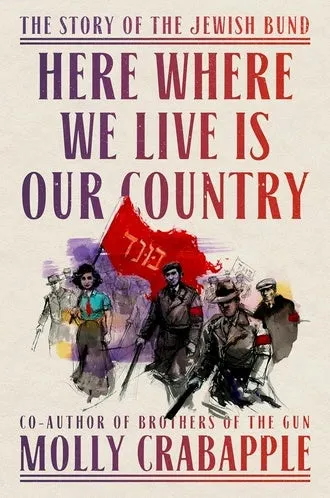
Here Where We Live Is Our Country
The Story of the Jewish Bund
by Molly Crabapple
One World (Penguin Random House), 2026

Who would have imagined a few years ago that masses of people around the world would be reading, praising, arguing over, and condemning a book about an obscure Jewish socialist organization that effectively came to an end nearly 80 years ago?1 A book about an uncompromisingly anti-Zionist organization? Who would have imagined such a book having rave reviews in the New York Review of Books 2 and The New York Times and being on the latter’s bestsellers list? 3
The Israeli state is carrying out a genocide in Gaza and ethnic cleansing in the occupied West Bank, and increasing apartheid laws inside Israel. Not only does the world stand by and allow this—the United States, United Kingdom, Germany, and Australia (where I live) support, arm, and encourage the Israeli government, and succumb to pressure to cancel and criminalize pro-Palestinian activity. The conflation of anti-Zionism with antisemitism means not just a distortion of Zionism and what it stands for, but a loss of the historical reality of antisemitism. It also results in a distortion of Jewish history, a loss of the history of the majority of European Jews of the first half of the twentieth century, who were socialists, not Zionists.
At a time like this, we need more than ever books that rediscover the other Jewish tradition, the history of radical struggle, opposition to Zionism, and socialism.
The General Jewish Labour Bund in Lithuania, Poland, and Russia, generally known as the Jewish Labor Bund or just simply the Bund, was founded in 1897 in Vilna (Vilnius, now in Lithuania) in the tsarist empire. It is one of the most important but least recognized socialist organizations in Europe.
In its early years, the Bund was revolutionary. It was the first socialist group to turn away from narrow circle work to agitation among workers in the late nineteenth century. It was also the first organization in Russia to implement many of the features we see today as characteristic of the revolutionary party: an agitational paper, professional revolutionaries, and the need for the party to be rooted among workers. The Bund also took the lead in organizing systematic self-defense against pogroms, which were endemic in the tsarist empire.
Because of its resources and organizational skills, the Bund was central to organising the First Congress of the Russian Social Democratic Labour Party (RSDLP) in 1898. By the Second Congress in 1903, it had 30,000 members, compared to 8,400 total for the other affiliates. Before the 1905 Revolution in Russia, one third of the prisoners in the Siberian labor camps were Bundists, and the party played a key role in that revolution.
At the 1903 Congress, the Bund opposed Vladimir Lenin’s concept of the party. However, after the 1917 revolution, a sizable group broke away from the Bund and joined the revolutionary movement. The remaining Bund organization relocated to newly independent Poland, where it affiliated with the Second International.
But there was little scope for reformist careerism under Józef Piłsudski’s authoritarian regime, and even less during the increasingly fascist period after he died in 1935. Subservience did not save the Polish Communist Party from destruction by Joseph Stalin. With Trotskyism virtually nonexistent, many of the best working-class activists were to be found in the Bund and in the Polish Socialist Party, also a member of the Second International. As they had done previously, the Bund continued its working-class-based activities, organizing workers into trade unions and leading self-defense groups against increasing fascist antisemitism.
During World War II, the Bund also played a critical role in resistance to the Nazis, most notably during the Warsaw Ghetto Uprising in April 1943.
So much of this story appears to have been forgotten or relegated to footnotes. While there is a significant body of literature on the Bund, it has been treated as a niche topic, one for specialists in Jewish history.
In Here Where We Live Is Our Country, Molly Crabapple has written a work of popular history. Although the author has undertaken original archival research, the book is unapologetically non-academic. To read it is more like reading a novel, a thriller, or a family saga. It is a page-turner, with a large cast of actors and vigorously drawn characters. Events are fast-paced, and the story unfolds against a backdrop of wars, revolutions, civil unrest, and local conflicts.
Above all, this is a book about people’s personal experience. Crabapple is a visual artist, and reading this book is like watching a series of vignettes passing before your eyes. Central is her great-grandfather Sam Rothbort, who at 15 became an activist Bundist in the small town of Volkovysk (present-day Belarus). Rothbort participated in Bund-led strikes and gatherings in the forests, but eventually fled to the United States in 1904.
Crabapple never knew her great-grandfather, but she did have a wonderful source of material in a shoe box of memorabilia, handwritten memoirs, and hundreds of paintings he left behind. This treasure trove inhabits the book almost as a living entity. Throughout the book, she draws on memoirs, letters, and personal accounts of many Bundists, men and women, young and old, leaders and rank-and-file members. She shows them to us as living human beings who were active players in history.
Far from using an authorial distance and objectivity, Crabapple tries to enter the minds of her protagonists, to write subjectively. She speculates about how individuals must have felt and thought.
Here is an example from the 1905 Revolution, sparked by the mutiny on the battleship Potemkin. Crabapple creatively describes the experiences of the Bundist soap box orator Anna Lipshitz:
Soon, to move between neighbourhoods, Anna would have had to weave around overturned tramcars and slip behind barricades…She would have witnessed the beatings of police officers…and likely heard the explosion of anarchist bombs. It must have thrilled her. This moment was meant to be hers…
Anna Lipshitz heard the news alongside the rest of the city. A battleship named Potemkin had just dropped anchor…It was flying a red flag.
Hoarse, bleary, her dress stiff with dried sweat, Lipshitz would have pulled herself off the floor of her safe house and joined the crowds clambering toward the port. The ship gleamed like a dream.
It is this sort of creative writing that animates this book, bringing to life the experience of revolution, war, and pogroms in a deeply effective way. We know, without it being articulated, that the dream that ends this passage is the possibility of a new world, one that inspired many participants in the revolution.
Some reviews have criticized this approach. But in my view, Crabapple’s use of this form of creative nonfiction is valid, as long as it’s clear what is actually factually based and what is imagined by the author. The book offers something sometimes lacking in historical writing, and helps the reader imagine historical events as they were lived. It gives the sense that revolutionaries and socialists are actual human beings with enthusiasms and foibles, strengths and doubts, dreams and hopes. And that they live without the benefit of hindsight and the analytical books that came after them. The personal experience approach takes us to a particular time and place, and gives the reader the feeling that they are accompanying the protagonists on this journey.
For example, when the Nazis invaded Poland on September 1, 1939, there were scenes of chaos. Crabapple brings these to life through realistic detail: the scramble to get news, organize meetings, make decisions, find food, locate relatives, and organize transport and visas. Their agonised debates: “All around Warsaw, rank-and-file Bundists were making similar calculations. Should they stay or run?” Crabapple does not take a position on this. She simply describes the dilemma.
The events of the Warsaw Ghetto Uprising in 1943 are already well-documented, but Crabapple gives us telling details. On the day it started, April 19, the Jewish Combat Organization battle squads mobilized at 2.00 am. “From balconies and windows, the fighters watched the nazis goose-step down Nalewki Street, singing a cheerful march. [Marek] Edelman had taken care to dress well that night, in a red angora sweater and two leather bandoliers, crossed like Pancho Villa. As he saw the convoy enter the ghetto, he imagined the Germans’ thoughts.”
We know quite a bit about Edelman, who is famous for his account of the Warsaw Ghetto.4 But who knew he was wearing a red angora sweater at that moment? The book is enlivened on every page by similar less well-known details.
Viktor Alter, who “liked the ladies,” was nicknamed “the Cary Grant of labor.” Bernard Goldstein is well-known for strong links to the criminal underworld, but he showed a softer side while in hiding during the Uprising, when he gave a young couple privacy in his apartment. Sophia Dubovna, when young, had a crush on the family maid (Sophia came from a rich family) and had briefly dated the right-wing Zionist Vladimir Jabotinsky. In 1934 she gave talks about love and sex at the Bund youth group, Tsukunft (Future). As a small child, Edelman had attended protests on the shoulders of comrades, “red flag in his tiny fist.”
The accounts of pogroms and the suffering and destruction in the book show very vividly what antisemitism actually is historically. In so doing, they reveal contemporary attempts to reduce the concept of antisemitism to uncomfortable feelings in the presence of political slogans or keffiyehs as a horrifying trivialization of the historical oppression of Jews.
The wonderful politics of the Bund shine throughout the book: its internationalism, its commitment to fighting antisemitism and to self-defense, to struggle, and to the working class. While the Zionists argued that antisemitism could never be defeated and so advocated emigration, the Bund promoted remaining and fighting against their oppression. But they took it even further. Using a biblical comparison, one Bundist declared that Jews should “stay and fight there, amongst the Egyptians, until they won a freedom that encompassed even their oppressors.”
Bund leader Henryk Erlich made a similar argument. In 1937, against a backdrop of rising antisemitism and daily attacks by Polish fascists, increasing immiseration, and a clearly imminent war, Erlich urged his audience to look past their own concerns:
You must briefly step out of the confines of your Jewish misery… Look about and you will see– the Jews are not the only ones who are suffering. The overwhelming majority in the country, whether Poles, Ukrainians, Jews, or others, is suffering from the economic crisis…scarcely able to eke out a daily existence.
Shift your gaze beyond the borders of Poland toward the wide world and you will see: Seventy million people are languishing under the heavy boot of Hitlerism. Not only the 500,000 Jews – the whole German people has been transformed into a nation of slaves… Forty million Italians have been turned into a footstool for the ‘great’ Mussolini… millions of working people in other, smaller countries which have become areas of reaction are sunk in privation and bondage.
Chaim Weizmann, leader of the World Zionist Federation in the interwar years, wrote in 1903 that their hardest struggle everywhere was conducted against the Bund. In return, the Bund described Zionism as “the most evil enemy of the organized Jewish proletariat.”
In 1933, Erlich wrote:
If Jewish nationalism, as a general rule, is not bloodthirsty, this is only out of necessity, not virtue; if an appropriate opportunity arose, Jewish nationalism would show its sharp teeth and nails no less than the nationalisms of other nations.
No we are not a chosen people. Our nationalism is just as ugly, just as harmful, and has the same inclination to fascist debauchery as the nationalisms of other nations.
In an open letter in 1938, Erlich summarised how they were the party that truly fought for the Jewish people: they had organized self-defense groups in tsarist Russia and in Poland, called protest strikes against pogroms, and argued against attempts to deport Jews.
In relation to Palestine, he wrote:
If a Jewish state should arise in Palestine, its spiritual climate will be: eternal fear of the external enemy (Arabs); eternal struggle for every bit of ground with the internal enemy (Arabs); and an untiring struggle for the extermination of the language and culture of the non-Hebraized Jews of Palestine… Is this a climate in which freedom, democracy and progress can grow?… Indeed, is it not the climate in which reaction and chauvinism ordinarily flourish?
Concentrating on personal experience gives Here Where We Live Is Our Country strengths. But the method also has its weaknesses. Foremost is a lack of analysis. One should not read this book expecting an evaluation of the 1905 Revolution, the Bolshevik/Menshevik split, the role of the soviets in the 1917 revolutions, the growth of Stalinism, the civil war, the coming to power of the Nazis, or the causes of World War II.
This is not the book’s objective, and these matters are very well covered elsewhere, but the lack of context is at times frustrating. While Crabapple features quotes and summaries of discussions, I wanted her book to engage more fully with the organizing principles and politics of the Bund. Consider the seminal event when the Bund sided with the Mensheviks in the famous split in 1903. Crabapple is dismissive: “Medem ruefully listened to rumors that the Iskrites had begun to fracture over the question of party membership. Should the RSDLP be a mass party of workers, as Martov envisioned? Or should it be the top-down conspiracy Lenin wanted, in which a central committee commanded and a full-time cadre obeyed? ‘Lenin had bared his teeth,’ Medem wrote.”
Crabapple goes on to describe Lenin’s “personality traits that would shape the coming century.” Quoting Medem, she concludes Lenin resembled “a crafty Russian grain dealer… When you speak to him, he looks at you with his small eyes…(and) cunning devilish smile.”
As Donny Gluckstein asks, “whether or not that characterisation was true, was Lenin right to believe a decentralised RSDLP facing the most centralised authoritarian state in the world was ‘a recipe for failure’?”5 Nathaniel Flakin also points out how the focus on Lenin’s personality prevents Crabapple from seriously grappling with the Bund’s political weaknesses and strategic mistakes.6
The concentration on personal experience also results in a lack of appreciation of collective experience and of competing social forces. This is particularly obvious in the account of the 1905 Revolution, in which her depiction of the turning of the tide is graphic but occurs for no apparent reason. The same happens with the growth of antisemitism in interwar Poland.
This lack of social context results in an absence that is significant. Although the Bund became the leading Jewish organisation in Poland, it was not the only outlet for Jewish radicalism: Jews were prominent in other Left organizations. There was significant Jewish membership in the Polish Communist Party and the Polish Socialist Party. The left Zionist group Poale Zion joined in self-defense groups. None of this appears in the book.
Here Where We Live Is Our Country has been rightly celebrated for its account of the Bund’s commitment to “Doykait” (“hereness”), meaning that Jews should not go elsewhere to escape discrimination but were entitled to equal rights and justice wherever they lived. Most writers seem to assume this meant that the Bund itself could be at home in any country. Yet it is abundantly clear that, although they were internationalist in spirit, the Bund’s roots were essentially in the Eastern European Yiddish-speaking working class, in particular in Poland by the 1930s.
The Bund did not, in fact, transplant well. In the United States, with its more than two million Jewish immigrants, the Bund organization was small, mostly active in raising money to send to Europe and in the welfare-oriented Workman’s Circle and focusing mainly on cultural work and the promotion of the Yiddish language. While Bundists were likely involved in the mass strikes among Jewish clothing workers in New York before World War II, among which socialists were very active, the Bund played no clear role as an organization.
Although there were individual Bundists in the United Kingdom who participated in a range of activities with other socialists, their work concentrated on collecting money for Poland and promoting Yiddish education.[footenote]Benjamin Nadel, “Bundism in England”, Jewish Socialist Group, Marxist Internet Archive, https://www.marxists.org/subject/jewish/jsg-bundism-uk.pdf[/footnote] The story is similar in Australia.
This explains why the book ends when it does. The Holocaust destroyed the Bund’s roots among the Yiddish-speaking Jewish working class of Eastern Europe. As the war-torn regions of Europe slowly reorganized after 1945, the remaining Bund members tried for a time to hold on to their principled politics, particularly anti-Zionism. In two articles in 1948, the Bund leadership warned its readers that “the partition of Palestine and the creation of an independent Jewish State would lead to a new catastrophe, not only for the Jews in Palestine but for the Jews all over the world” and “the country became from the very start a source of Irredentist movements, Jewish-Arab conflicts, and an open threat of war.”7
These articles generated a “veritable deluge” of condemnation from the entire Jewish press and the Jewish community as traitors. The Bund response was to argue, “We shall not be diverted by any temporary nationalist trend.”8
Unfortunately, the trend was not temporary. With the state of Israel firmly established, and the core organization in Poland destroyed, remnant groups in other countries faced a dilemma. The historian of the post-war Bund, David Slucki, shows how the movement came to a pragmatic accommodation with Zionism.9
Paradoxically, new international organizing principles allowed the local Bund groups to focus more on local activities, where they tended to straddle “the divide between mainstream Jewish communities and the non-Jewish socialist left.” Despite continued talk about socialism, bundists in the post–World War II era now saw “cultural continuity as their chief mission.” Thus, despite the formal opposition to Zionism, pragmatism led to an accommodation with Zionism, leading Bundists in Australia and elsewhere to send money to Israel.
The political consequences became evident following the events of October 2023. Although some members of the Australian Bund are conspicuous and principled supporters of Palestine, the organisation has forefronted defense of Israel, publishing only three very short and weak statements (and none since 2025).10 Writers associated with the Bund have even criticized Crabapple’s book as seeking to “delegitimise Israel” and even as “hijacked by anti-Zionists.” 11
It is sad to see contemporary Bundists repudiating their own history.12 But this history remains available to the rest of us. Its existence and predominance stand against the Zionist claims to represent Jews historically. The Bund’s internationalism and its position on Zionism prior to 1948 are beacons to contemporary anti-Zionists.
And it’s clear that people are responding to this beacon. Jacobin applauds what it sees as the Bund’s “growing relevance,”13 noting that where “the Bund has long been regarded as a historical artifact, it’s now reasserting itself as a living tradition.” New groups are springing up under the auspices of a body called the International Jewish Labor Bund (IJLB),14 following its declaration in 2023.15 There are now 11 chapters or organizing committees in the United States and six in Europe, 16 plus an online journal, Der Spekter.17 (Interestingly, the remnant groups in Australia and elsewhere are not part of this movement.)
The renewed interest in the Bund, its history, and its ideas, not surprisingly, has not been welcomed by everyone. Many of the negative responses to the book are trifling. Objections to Crabapple’s Puerto Rican roots, questioning whether she really is Jewish, and her past work as a burlesque dancer have only added fuel to the fire.
Not surprisingly, Zionists have led the counter-attack. Their responses are defensive, and often abusive. Their fire is directed not at the book’s primary readership, but at a Zionist audience among whom this book (or the publicity it has generated) might raise doubts. A review in Haaretz is typical.18
One strategy is nit-picking very small errors: Eliezer Aryeh, for example, devotes several articles to a forensic analysis of Crabapple’s nearly 2,000 endnotes and comes up with four errors.19 Others complain that Crabapple “oversimplifies,” is “selective,” or makes “no attempt at representing historical accuracy. Seth Mandel, a conservative anti-Trump Republican, hardly touches on the content of the book at all, but claims (without evidence and despite many of the rave reviews being written by Jews) that the prevailing opinion among Jewish writers is that Crabapple’s book “exhibited a heartfelt nostalgia for a time and place that never really existed…it is a fictional story.”20
Writing in the Jewish Review of Books, Allan Arkush goes further, claiming Zionism “has by and large been rooted in humanitarianism, led by noble men and women dedicated to constructing and sustaining a Jewish state for the benefit of their own beleaguered people and, indirectly, for others.”21 The Wall Street Journal review, written by a British Trump supporter apparently with the use of AI, regurgitates standard support for Israel for a non-Jewish audience.22
This book is not an academic study. The bibliography is small. Crabapple certainly carried out extensive new archival research, resulting in fascinating personal detail about her protagonists. But the book is rightly focused on introducing the Bund to wider audiences. The need today is not for more academically rigorous studies, to be read only by a limited audience, but for the core ideas in this book—struggle, resistance, solidarity, social justice, and above all socialism—to be spread further.
Whatever its limitations, Here Where We Live is our Country is a wonderful new addition to the history of the Bund and, through this, to the broader tradition of Jewish radicalism and socialism of which it is a part. This history is a part of our collective story, and its legacy belongs to all of us. Read this book in that spirit.
Opinions expressed in signed articles do not necessarily represent the views of the editors or the Tempest Collective. For more information, see “About Tempest Collective.”
Featured Image credit: Unknown; modified by Tempest.

We want to hear what you think. Contact us at editors@tempestmag.org.
Janey Stone View All
Janey Stone is the author (with Donny Gluckstein) of The Radical Jewish Tradition (Verso, 2026).