
Confronting the ecological crisis
A review of Ian Angus’s Metabolic Rifts: Capitalism’s Assault on the Earth System
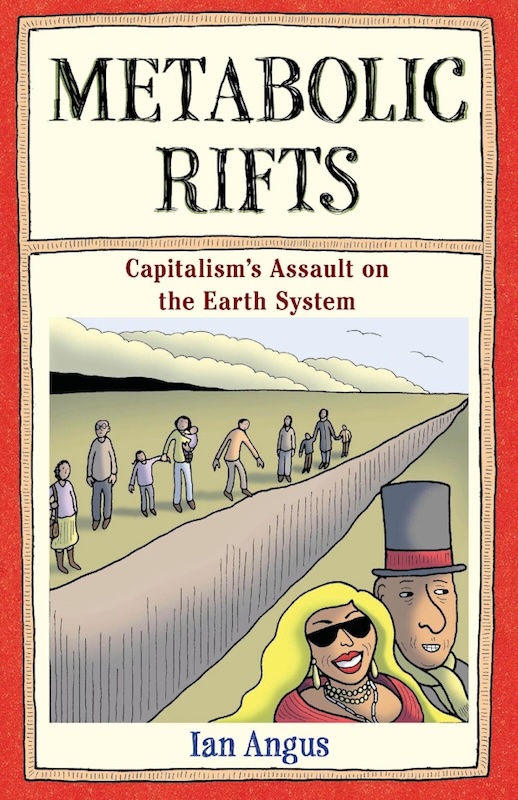
Metabolic Rifts
Capitalism’s Assault on the Earth System
by Ian Angus
Monthly Review Press, 2026

The ecological crisis is upon us. It touches everywhere on the planet. Its character is complex, manifesting in floods, fires, disease, eradication of forests and fisheries. Interacting factors worsen globally connected catastrophes.
Ian Angus’s Metabolic Rifts: Capitalism Assault on the Earth System makes an important contribution to understanding and guiding a socialist response to these compounding ecological crises.
Angus is an ecological Marxist scholar and founding member of the Global Ecosocialist Network. Metabolic Rifts connects modern science, history, and Marxism’s metabolic rift theory.
Angus says that our ecosocialist politics
must be based on a concrete scientific understanding of how our world has evolved, how it is changing today, and where those changes may take us. The way we build socialism, and the kind of socialism that can be built, will be profoundly shaped by the state of the planet we must build it on. If our programs and activity don’t have a scientific basis, all our efforts to change the world will be in vain. (5)
The book accessibly explains metabolic rift theory, the key insight of Marxist ecology. For Karl Marx, Frederick Engels, and subsequent Marxists in this tradition, the Earth’s metabolism is not a metaphor but a material reality. Interacting social, biological, chemical, and geological processes make life possible.
Metabolism
Marx used the concept of metabolism in three related ways. First, there is universal metabolism, Earth’s life-support system. This refers to the biological, chemical, and geological cycles on which all life depends.
Social metabolism is the way human society relates to the rest of nature. Social orders change over time, and class society—and then capitalism marks a significant historical shift.
Finally, metabolic rift is capitalism’s tendency to disrupt Earth’s cycles. The key factor driving this disruption is the subordination of human needs to capitalism’s drive for profit and accumulation. This process breaks the metabolic connection between humans and the rest of nature. Capitalism cannot change the natural laws governing life itself.
Drawing on soil science, Marx first analyzed the rift between town and country. In England, working-class urbanization and the separation of agricultural production and people meant that the food and human wastes previously returned to the soil flowed as pollution into rivers. This process broke the nutrient cycle and undermined soil fertility.
The metabolism of the earth includes material and energy cycles operating on time frames ranging from hours to hundreds of millions of years. These include the water cycle, the carbon cycle, and the nitrogen cycle.
With the attention rightly given to global heating and disruption of the carbon cycle, which is mostly caused by fossil fuels, other disruptions, like with the nitrogen cycle, are less appreciated, although no less important. A handful of healthy soil contains hundreds of millions of microorganisms. Soils are the most species-rich habitat on Earth. Healthy soil is necessary for fertility and absorbing carbon, and for nutritious food.
Angus traces the history of soil destruction to the town-country rift, which then led to imperial struggles to secure nitrogen-rich guano deposits to restore fertility. Ultimately, there was the development of industrial production and its complex of cash crops and fossil-fuel-derived nitrogen fertilizer. Farmers grossly over-apply nitrogen fertilizer, wasting two-thirds of it, polluting water and air, and disrupting a key Earth System metabolic cycle.
Capital versus the Earth System
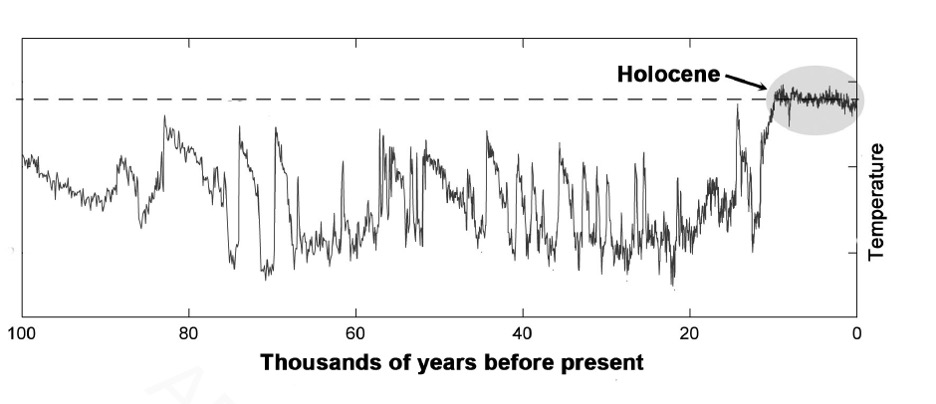
The main part of Angus’s book is titled “Capital versus the Earth System.” It traces the ecological revolutions, including photosynthesis and land-based organisms, through which life and the rest of the planet historically co-evolved. This evolution created the conditions for more life and, ultimately, the stable equilibrium of the Holocene epoch over the last 10,000 years. Historically, relatively small changes in temperature or oxygen levels supported large changes in the biosphere. This insight is important for understanding ecological tipping points, when incremental change exceeds a threshold and may cause major changes in the Earth System.
Angus summarizes the distinctive anti-ecologic logic of capitalism as being characterized by “generalized production of commodities: profit maximization; competition among multiple capitalist; short-termism, and unending accumulation” (115).
These are inter-related dynamics that, among other outcomes, lead to uncontrolled growth. Ecologically, this means an ever-increasing linear flow of material and energy through the system that is in direct conflict with the universal metabolism. Angus writes,
The growth imperative is not, as liberal environmentalists often argue, just a mistaken policy or a false ideology. It is a fundamental structural feature of capitalism. Uncontrolled growth is an inevitable result of the profit system, of capitalism’s inherent drive to accumulate ever more capital.” (122)
The Anthropocene epoch
Angus has been an important proponent of the theory that we have entered into a new Anthropocene epoch. On this view, the Earth has transitioned from a period of temperature and ecological stability known as the Holocene and is now in the capitalist-driven and unstable period of the Anthropocene, a qualitatively new geological epoch where human activity has fundamentally reshaped the Earth.
The reference point for this thesis is the post-World War II period known at the Great Acceleration. This marks an unprecedented era of fossil fuel enabled economic growth.
The charts below show the general trends.
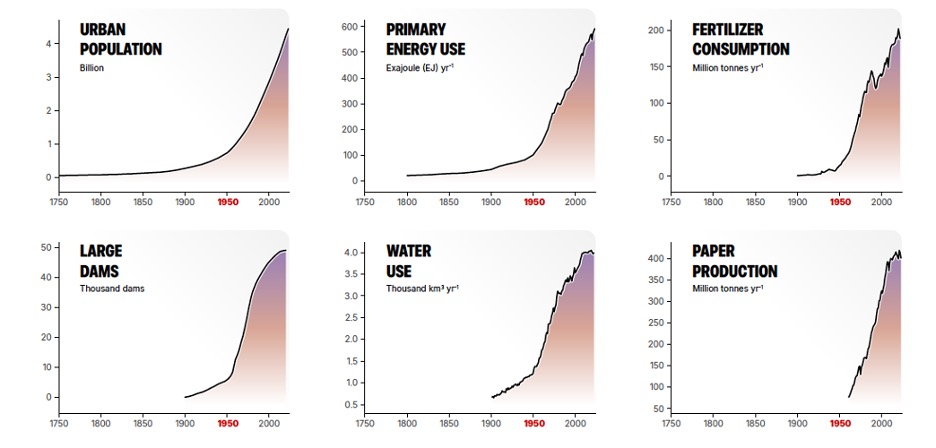
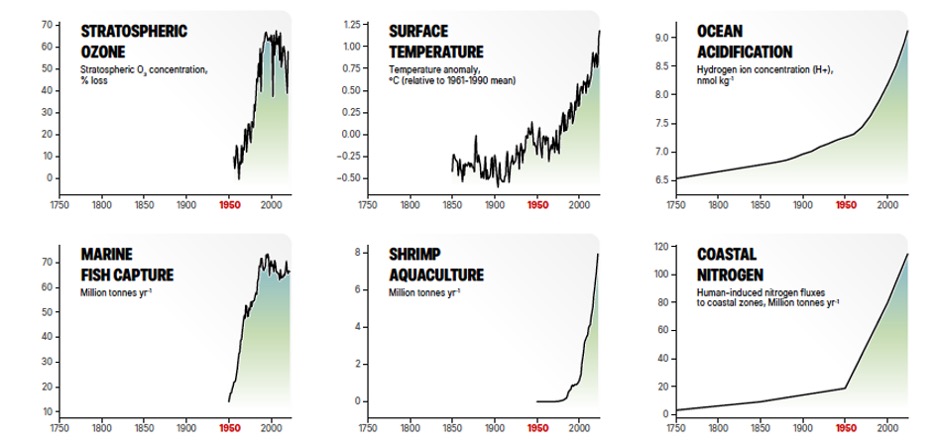
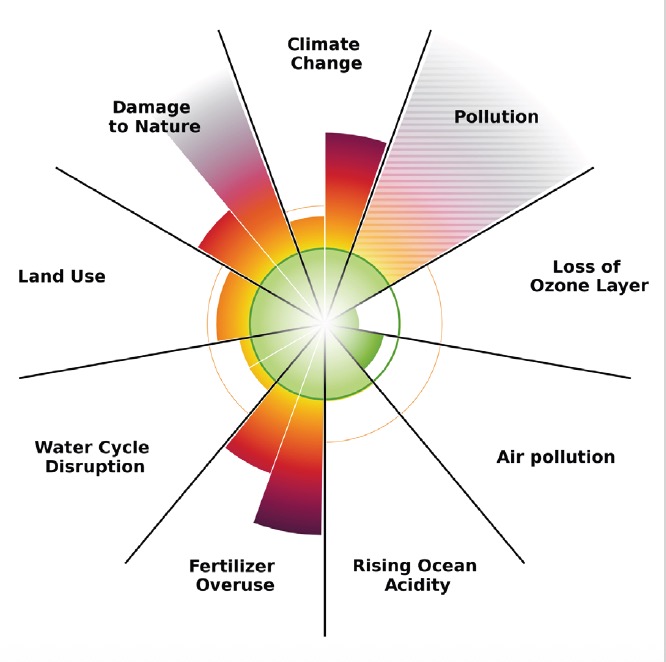
In an Earth Systems framework, the result of capitalist production is that key planetary boundaries for maintaining a stable biosphere are being exceeded.
The ecological crisis is much more than about global heating and the need for green energy at scale. Exceeding boundaries also risks creating new tipping points, producing even worse outcomes. In one global heating scenario, for example, after a certain point of warming, a cascade of factors could set in to produce Hot House Earth, an environment inhospitable to human society and many existing forms of life.
Scientists share with socialists and millions of oppressed and exploited workers a sense that we need a radical break with the status quo to resolve escalating crises and deteriorating living conditions. Angus quotes from the 2018 landmark earth science article “Trajectories of the Earth System in the Anthropocene,” published in the Proceedings of the National Academy of Sciences:
“Incremental linear changes to the present socioeconomic system are not enough to stabilize the Earth System. Widespread, rapid, and fundamental transformations will likely be required to reduce the risk of crossing the threshold and locking in the Hothouse Earth pathway: these include changes in behavior, technology and innovation, governance, and values.” (215)
Ecosocialist strategy
While revolution must be the goal of ecosocialists, this doesn’t mean we have no options for immediate political struggle.
Ecosocialists need to help elaborate necessary non-incremental and revolutionary social and ecological changes. But we must also contribute politically and practically to immediate fights for reforms.
Angus makes the case that our collective goal can’t be to govern nature, as capitalists and ecomodernists urge, but to democratically govern our dynamic interaction with the Earth. For Metabolic Rifts, a guiding goal is expanding the commons—the democratically regulated and accessible provisioning of our basic needs. Housing, education, healthcare, and food shouldn’t be commodified but freely available to all.
The original expropriation of direct producers from the land was integral to early capitalist development. Solving the general metabolic rift requires overcoming the social rift between workers and their communities from the means of livelihood.
The long process of original expropriation, of evicting peasants from the country and forcing them into cities, was a long, extremely violent, and contested process in Europe. Ian Angus’s earlier book The War Against the Commons: Dispossession and Resistance in the Making of Capitalism chronicles this history and points to the role of popular resistance and the need to reestablish a conception of the commons.
Other goals—from closing fossil fuel corporations and expropriating agribusiness, to banning single-use plastic and other chemicals that nature cannot absorb and recycle, to paying international ecological debts and abolishing the U.S. military empire—would be part of the revolutionary transformation to ecosoicalism.
Immediate reforms are challenging—and will not immediately affect the global crisis. But we must engage in struggles that people can learn from and that can have real-world impact. The expansion of the global commons can only come about through the mass struggle of the global working class, indigenous communities, and colonized peoples.
From halting fossil fuel infrastructure, closing data centers, taking back public water supplies, and demanding public housing and transit to the struggle for a free Palestine and end to genocide, everything has an ecological dimension.
Our challenge is to bring the broad scope of ecological breakdown and the need for democratic social and ecological renewal into all our struggles. Metabolic Rifts helps us do this.
Opinions expressed in signed articles do not necessarily represent the views of the editors or the Tempest Collective. For more information, see “About Tempest Collective.”
Featured Image credit: Monthly Review; modified by Tempest.
We want to hear what you think. Contact us at editors@tempestmag.org.
Paul Fleckenstein View All
Paul Fleckenstein is a member of the Tempest Collective in Burlington, Vermont. He is a labor and environmental justice activist.