
Put workers and patients first!
Town hall meeting with UVM Medical Center unions

Vermont’s main hospital, the University of Vermont Medical Center, is threatening cuts in staffing and wages as well as services in contract talks with UVM Medical Center Support Staff United. The hospital’s parent company, UVM Health, has already eliminated 140 positions. A third of those were union positions.
The Green Mountain Care Board (GMCB), which oversees the state’s hospitals, has mandated that UVM Health overcome its $300 million deficit with more cuts in expenses over the next three years. The cause of this fiscal crisis is not the healthcare system’s workers and patients, but its bosses, their profligate pay, and their mismanagement of the system.
The former Chair of GMCB, Owen Foster, underlined this fact during a board meeting last September. He stated, “It’s essentially an expensive and ineffective layer of overpriced and unnecessary corporate bureaucracy that has proven itself both physically and spiritually distant and unconnected from the mission of our flagship academic medical center and the needs of Vermonters.”
In the midst of this crisis, entirely caused by management, UVMMC Staff United is drawing a line in the sand. The workers are fighting for a fair contract that would put workers and patients first. Their struggle may result in a strike.
The stakes are high. The union is holding the line against the proposed cuts and demanding that the Medical Center ensure safe patient-staff ratios that would improve everyone’s healthcare. They’re also insisting that it sign on to Migrant Justice’s Milk with Dignity program, which protects farm workers’ rights and ensures them better wages, working conditions, and housing.
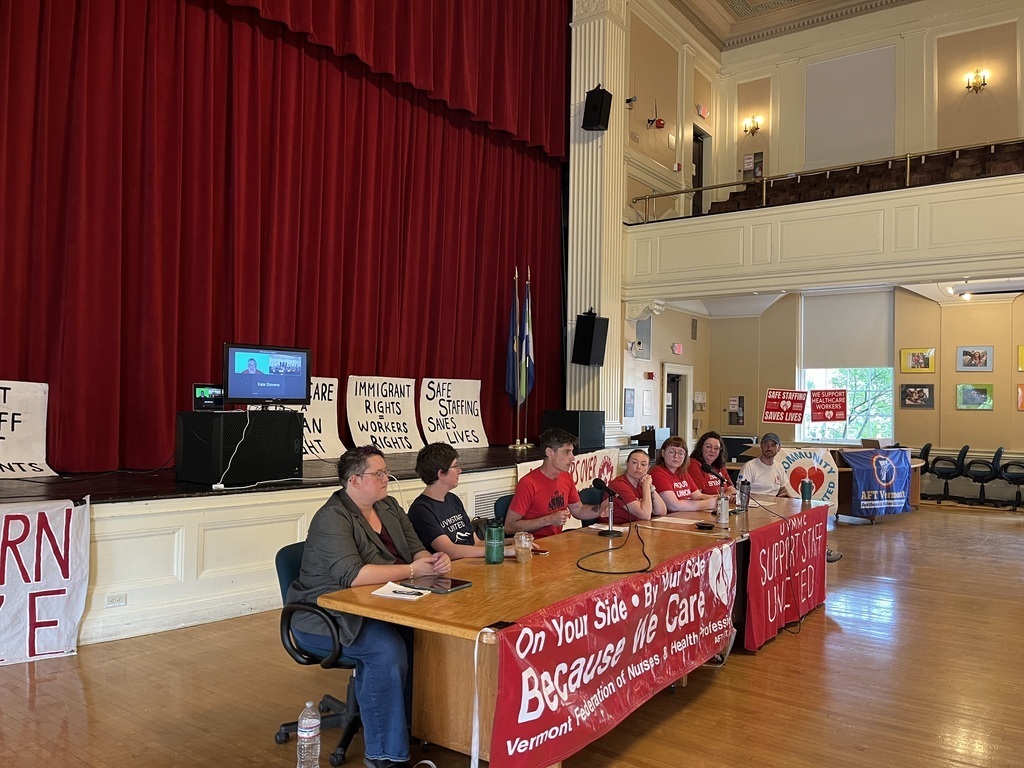
This panel (video here), organized by Vermont May Day Strong, featured union leaders from impacted healthcare and education unions in Vermont as well as Plattsburgh, New York. The speakers included Melissa Lavalle and Teagan Cook (UVM Medical Center Support Staff United), Jessica Jacobs (Vermont Federation of Nurses and Healthcare Practitioners), Chris Swiesz (New York State Nurses Association), Lou Rochford (Community Health United), Deirdre Manion-Fischer (UVM Staff United) and Matt Gile (Winooski Education Association). This transcript of their speeches has been lightly edited for clarity and brevity.
Melissa Lavalle: For forty hours a week, I’m the financial and administrative assistant for the psychiatry and mental health departments. I’ve been doing this job for eight years. When we started, it was just for UVM Medical Center, where I work. As of this week, my work has expanded to include Plattsburgh and Elizabethtown, New York, as well as other hospitals in Central Vermont.
I am secretary of Support Staff United as well as vice president of Healthcare for AFT Vermont. When we started talking about bargaining, we realized that both staff and technical workers’ contracts were expiring at the same time. We all know that when we bargain together, we are stronger together.
So, we made sure that we were all on the same page ideologically. We sent out our bargaining survey in both units and our members’ responses showed that folks wanted the same thing, and that the primary thing that they wanted was safe staffing.
We know this is an incredibly hard economic time all around. Our folks are not immune from that in any way, shape, or form. But hospital workers aren’t hospital workers just because they want a fat paycheck. They care about the community and care about providing quality healthcare to the community that we’re all part of, that our families are part of, and that our friends are part of.
After deciding that staff and tech workers bargaining together was going to be the way forward, we combined our economic demands with some common good articles. We believe that we have the opportunity now to start a wave of social justice unionism.
We are asking the hospital to be a part of Milk with Dignity. Our hospital serves a lot of milk. We would like to know it’s coming from farms that treat their workers properly. This is personal for me. I grew up on a farm and know how hard the work is. My parents’ biggest and most effective threat to me was that if I did not behave, I was going to have to work on the farm.
We’re also asking that the hospital not use their very expensive lobbyists and publicity department to fight us in our struggle for universal healthcare for Vermonters. The hospital’s tight on money, so if they agree to not waste it on opposing us in the legislature, we can save them a lot on lobbyists and consultants.
We wrote up these common good proposals and brought them to our 3,300 members. We got a supermajority to sign on to them. Our people are behind us. They want us to use our union power to improve our working conditions, make sure we are running a safely staffed hospital that can properly care for its patients, and improve the community that we are all a part of.
I think we can all see that for-profit healthcare is not working for any of us. It’s not working for healthcare workers. It’s not working for our patients. It’s time to end the delusion that for-profit healthcare can ever work.
We know there are alternatives. I’ve been to Holland. I’ve been to England. They are not shitholes. People are not dying in the streets. We deserve the opportunity to have healthcare as a human right and that’s what we’re fighting for.
Teagan Cook: I am the operations support specialist at UVMMC. I know that doesn’t mean anything to anyone because they have very obfuscating titles there. What that means is that I am the lead chemotherapy scheduler for outpatient cancer patients.
We have about 54 providers who can prescribe this kind of treatment in our outpatient section of UVMMC. We have seven schedulers. And that is frankly a pretty high scheduler-to-provider ratio compared to some other places in the hospital.
But we have a unique level of complexity that has caused our understaffing to become critical to the point where I think that we are on the verge of a sentinel event in our clinic any day. If you’re not aware of what a sentinel event is, it is severe patient harm or death due to some kind of mistake by the hospital. That mistake is staffing.
If you get diagnosed with cancer here, you’re going to be sent to the outpatient hematology oncology clinic. What’s going to happen is you’ll have an initial visit with your provider. They’re going to decide what kind of treatment is necessary, and whether surgery is necessary.
They might send you over to surgical oncology for a consult there. Then you’ll come back over to medical oncology, and you’ll get prescribed treatment. And that sounds like a pretty simple thing to schedule.
Unfortunately, a lot of these medications are extremely difficult on the body. For example, a lot of these medications are really hard on your veins, which means that in order to give a patient some of these medications, they have to have a PICC line placed, which is a little tube that goes directly into your heart, or a port placed, which is a plastic device with a tube that goes directly into your heart.
That way, we’re not doinking your veins every time we give you medication. We have, I think, three providers in interventional radiology who can place those ports. We have to get that coordinated with getting an echocardiogram of the patient’s heart to make sure that they are physically fit enough to receive this medication without massive side effects.
We have to coordinate with our specialty pharmacy to give any oral meds that the patient might need. We have to coordinate with our on-site pharmacist to talk to these patients about the treatment that they are receiving because there are a lot of really weird side effects and a lot of really weird no-nos.
For example, there’s one medication that we give where you can’t drink anything cold or your nerves stop working. So, it’s really important that we have all of these things figured out and put together.
That is the kind of thing that we would have to get scheduled out for one visit for one patient, and we haven’t even talked about actually getting the juice in them yet. It’s an incredible amount of coordination for each scheduler, for each different provider that they’re scheduled for. The medications are different depending on the diagnosis, depending on the provider, depending on whether or not the provider does research studies.
We are also operating with an extraordinarily limited amount of chair space, and those chairs are physical chairs where people have to sit and be under the supervision of a nurse to receive their medications. I am not aware of a single person on my team who has not had some kind of stress-related health issue in the past several months.
I was asked by my boss to leave work early on Friday because I was having a stage two hypertension episode. People are getting migraines. I have people on my staff who cannot have conversations about what we are going to do when one of our staff members leaves because they get panic attacks immediately.
We are not in a position to be able to care for our patients anymore. All of us are terrified all the time that we are one mistake away from getting someone killed, that we don’t have enough oversight available. My team has not had a practice supervisor for months now. We’re struggling desperately, and we are trying so desperately to get management to listen to us.
I’m on step three in a grievance process to get us more staffing. The solutions that have been presented to us so far are things such as, “You could try working faster.” We can’t get overtime. We can’t get more staff. It takes us about three months to train someone due to the level of acuity in our work. And again, we are not the worst-staffed clinic.
The reason why I’m here is because a rising tide lifts all boats. If we can win a good contract with common good demands met like Milk with Dignity, it will do amazing things for all of us. But if we don’t get safe staffing, if that one load-bearing aspect of our contract is not fulfilled, people are going to die.
It is going to be people who you see every day. It’s going to be people who work at the hospital. It’s going to be people who work for other healthcare organizations. It’s going to be people who work here in City Hall. And that’s simply the fact of the matter.
We do not have the adequate staffing to sustain human life in our hospital anymore, and that has to change. That’s why I’m here and that’s why a large number of our members are fighting so hard for this contract, because we are afraid for you. We are afraid for ourselves. This is not a simple matter of just it’d be nice to get another five dollars an hour. It’s a matter of life and death.
Jessica Jacobs: I work in the sleep center. I have worked there for about 16 years, 15 of which I’ve worked the night shift. This year I transitioned to a second shift position due to health issues caused by working nights. I’ve been there a long time. Along the way, I’ve seen a lot of changes.
We are definitely experiencing safe staff issues. We have shortages and a high turnover rate, especially on the night shift. It’s difficult to recruit new staff. Wages are just not high enough for the cost of living. We get people who apply from out of state and once they see how much it costs to live in Vermont, they don’t come.
We’ve also had to hire staff who we know are going to stay for a short time because it’s just a stepping stone for them before applying to medical school. But the training time is very extensive. It’s about six months to get you at the baseline. Even after that, you’re learning for many years and you still need the assistance of senior staff, which we have very few of. We have two senior staff on nights and three relatively new people, two very new.
When I started at Sleep, we had anywhere between eight and ten night techs. We would occasionally hire a traveler, but not for very long. We currently have two travelers and a third who will be joining us in August. It’s the most we’ve had ever.
The issue with recruiting and keeping new staff is that the work is just too hard. The patients are sicker, and we’re being asked to do too much. It’s too stressful. For our senior techs, it’s a little easier. But it was even challenging for me towards the end of my stint on nights. So, for new staff, there’s just no reason for them to stay.
When we are short-staffed with our night staff, it prolongs the wait for patients to be seen for their sleep studies. So, right now for our in-lab sleep studies, we are booking out to January for adult patients and into February for pediatric patients. The pediatric patients often need to be in a one-to-one ratio, so it pushes them out a little further in the calendar.
With a lot of our adult patients, they have what we call a two-to-one ratio—two patients for each tech worker over the night. But now, because the patients are sicker, those two patients you’re working with take more care and attention. So, it’s very challenging.
The hospital has not kept up with this reality. They have not changed those ratios to reflect the patient population we’re seeing. That’s a big reason why it’s so challenging for our newer techs.
And it’s worse for the patients. If they have their sleep studies delayed, they’re getting their treatment delayed. That puts them at higher risk for heart disease, heart attack, and stroke. Those conditions put them at higher risk to be admitted into the hospital on our inpatient floors. So, our understaffing contributes to overwhelming the whole system, which is understaffed overall.
The other challenge with our traveling techs is a lot of them are not equipped to deal with what we’re experiencing in our lab. They can kind of get by. We can get studies run, but we’re not providing the same quality of work.
The hospital has simply not invested enough money in the sleep program for a long time. We operate out of a hotel, which we’ve been doing since I started. The majority of our sleep studies are in a hotel. It is nice because it’s a little more comfortable, but it’s not the best solution.
Where we work at the hospital, the building’s very old. It’s not really set up well for us. Our equipment is old. It’s failing. And they’re not investing in new equipment. That forces the tech to take time away from care to troubleshoot the equipment and do things like change out old sensors for new ones. It disrupts the patient’s test. It disrupts the patient’s sleep.
All this delays treatment and compromises its quality. If anyone has experienced a sleep condition or knows someone who has, you know that what I’m describing is detrimental to people’s health and their ability to function in life. We’re fighting to change this situation for all our benefit.
Chris Swiesz: I’m a registered nurse at Champlain Valley Physicians Hospital (CVPH) in Plattsburgh. I’ve been there for twenty-five years, and I’m a member of our union’s executive committee as the grievance co-chair. We’re here today to send a clear message to the management of UVM Health that members at CVPH are in solidarity with the AFT members at UVMMC.
This is a fight for our communities and for good union jobs. We all need to fight together to save our essential healthcare services. We are all tired of being asked to do more with less. We are sick of having to pay for management shortsightedness and poor planning. Instead of cutting executive pay, administrative overhead costs, UVM Health is cutting frontline staff and services.
They are cutting the workers who make our healthcare facilities run. That is not right, and that is totally unacceptable. Our contract at CVPH expired December 31. We are nearly nine hundred nurses and healthcare professionals strong. We are demanding safe staffing, fair pay, and staff retention.
As of now, we are taking measures to escalate our efforts if management continues to play games at the table and does not engage in issues that matter most to all of our members. Just as we will not stop fighting for our community, we know that AFT members are just as passionate in the fight for quality healthcare.
I know that you are not done fighting. Know that we are with you. Know that we are with you in solidarity. When the UVM workers stand united, we will never be defeated. We are with you, and we’re in this fight with you.
Lou Rochford: We at Community Health United (CHU) are grateful to join this panel. I’m the treasurer of our union and one of the employees impacted by the recent layoffs in the Community Health Centers’ Health Information Management Department, also known as the medical records department, if you don’t know hospital jargon.
I’ll be transferring into a new position that I took as an alternative to being laid off. For those who may not be familiar with what’s been happening, CHU has spent the past two weeks responding to job cuts that followed Community Health Centers’ decision to contract with the third-party billing company, Medusind, in May 2025.
This is the third round of layoffs we’ve had in less than twelve months. Management recently clarified that they only count this as the second round in 2026. They recently clarified this because they only count this as two rounds because the first round was per diem employees.
But, if you’ve ever worked per diem, you know you have a job, but you’re not guaranteed to keep that job because it’s day by day. Nevertheless, it’s still a job, and if you’re laid off, you’re laid off. So, we’ve had three rounds of layoffs.
CHU is still a young union for support staff. Our first contract took effect in 2023, and until now we really haven’t made a lot of noise. What has been inspiring is watching our members come together in this difficult time. The billing department, which has borne the brunt of these layoffs, gathered more than 120 signatures on a petition in just forty-eight hours of the layoff announcement.
For a young union, that’s remarkable. It tells me our members aren’t just fighting for themselves. We’re fighting for each other, for their patients, and for the community health centers.
We met management because we believe layoffs should be the last option, not the first, and we ask for transparency around the organization’s finances, meaningful collaboration to find alternatives to layoffs, an end to spending millions on outsourcing, transparency around the Medusind contract, a CHU-appointed seat on the board of directors, and a commitment to advocate alongside us for union voices healthcare in the next legislative session.
Management has shown themselves to be incompetent. Our Chief Financial Officer, Patty Bratton, made two mistakes in one day. She acknowledged that signing the Medusind contract had been a mistake. Second, after we requested the contract because even our CFO couldn’t tell us what it cost monthly, we discovered that it contains a clause allowing Community Health Centers to end the agreement after management told us that they cannot end it.
But management still kept information from us. They redacted copy of the contract we received. All the financial information was blacked out. We were told if a select few union reps wanted to see the unredacted version, we’d have to agree not to share the financial details.
You can decide for yourselves what to call that. I can only describe that as a non-disclosure agreement (NDA). We cannot agree to an NDA about information that affects our livelihood. Transparency shouldn’t come with a condition of silence. We told them that. But we haven’t received a response.
Before our recent press conference, we reached out to the interim CEO, Dr. Harry Chen, and invited him to sit down with us. His response was simple: “Thanks for reaching out. After consideration of your request, I’m going to respectfully decline.”
As someone who works in healthcare, reading that felt a little like seeing that pop-up that says, “This action may take a few moments.” Healthcare workers know that when you see that, we sigh and wonder what fresh chaos is about to unfold.
Management later defended these actions as strengthening the organization’s financial stability. We know that’s wrong and it will come at our expense. One of my coworkers was denied a replacement prosthetic from our new self-insured health plan after theirs broke. I spent about a month trying to resolve a billing issue for my own preventative care for diabetes care.
Healthcare doesn’t become stronger because a spreadsheet balances. Healthcare becomes stronger when we support the people who answer phones, fight with insurance companies, process medical records, schedule appointments, and help patients navigate a system that is already confusing.
So, our fight isn’t just against layoffs. It’s about what kind of healthcare system we want—one built on transparency instead of secrecy, collaboration instead of exclusion, investment in people instead of outsourcing. Because when workers lose, patients eventually will too.
That’s why we’re asking this community to stand with CHU, not just for our jobs, but for the future of the Community Health Centers, especially in Burlington. These centers are being closed all over our nation. We must stop that from happening here.
Deirdre Manion-Fischer: It’s a great honor to speak on behalf of UVM Staff United, which is the staff union at University of Vermont. I’m part of our leadership team and am a co-lead steward.
I work in the cancer center. I support opening clinical trials. I’m a regulatory specialist. I make Institutional Review Board (IRB) submissions and edit consent forms. I tell patients all the risks of the trials, and each unique trial has different care, different needs, and different requirements. That’s my day job.
I work closely with a lot of medical center staff. They’re the clinical coordinators. They’re the ones who see patients. They’re the ones who make sure all the data gets collected. We have data coordinators who enter all the data so that our patients can get the cutting-edge of care and get the newest trials and also get the data that we need to be able to have these drugs available on the market.
I’m also very active in UVM Staff United. I started here about three years ago. I became an area steward during my probation without knowing what it was. I just want to say that our unions need to stand together.
We’re not in the same place. But each gain we make sets a precedent for each other to fight for. And we’re all in the same medical system. We’re all patients. We’re participants on clinical trials. And our work affects each other. My coworkers are yours.
UVM Staff United have heard the same demands from management that you’re hearing, over and over in our bargaining. UVM’s goal is to reduce costs by rationing care. So, they offer us alternate healthcare plans that have a high deductible. As a result, people don’t seek care. Faced with that we’re saying no.
They call people who use our healthcare “frequent flyers” as if our care is a luxury that’s used. We’ve heard this over and over in these committees. And then during bargaining last time, it took us nearly a year to get a contract. If we had the right to strike, it would have been shorter.
But we still have a law on the books in Vermont that says we don’t have the right to strike. This is a Bernie Sanders state. Why do we have a law that says public employees do not have the right to strike? That has to be struck down. We need that bill in the statehouse to be passed that gives us the right to strike.
We’re all here because we care about patients and their experience. We care about research. We’re not here just to make a good paycheck. We’re here because we believe in the work.
And we’re your neighbors. We’re in solidarity with you. We share the belief in a fighting democratic union. That’s where our power comes from. Only by exerting that power can we get what we need.
We’re not going to get that by asking nicely. I train our shop stewards. I argue grievances. We don’t win them by being right or making the best arguments. We win them by flexing our power.
We know you understand that and are doing it now. So, when you guys win a better contract, we can look at it and say, “Hey, us too.” We all get more together. We all deserve what we need. We are in solidarity with your struggle. It’s ours too!
Matt Gile: I’m a librarian for the Winooski School District. I get to read stories with preschoolers all the way to twelfth graders. I’m also the former president of the Winooski Education Association. Currently, I’m the chair of our political action committee.
Education workers and healthcare workers are facing the same attacks to impose austerity on our schools and our healthcare facilities. Our bosses are using the real affordability crisis as an excuse without actually addressing the underlying cause of that crisis. And that’s our for-profit healthcare system, our for-profit housing system, and our for-profit system as a whole; these are extracting value from working people.
But education workers and healthcare workers also share similar strength. Our work is caring for those in our community. And that connection is so powerful. And so, we say educators’ working conditions are our student learning conditions, and safe staffing saves lives.
That is why it is so important that we’re together in solidarity on this panel right now. I’m really excited to talk about this new burgeoning Healthcare is a Human Right campaign that Vermont NEA and AFT Vermont has just launched. Also, and this is hot off the press from yesterday’s convention, the Vermont AFL-CIO has also committed to join this campaign.
This is all based on the unprecedented, astonishing work that the Workers Center had done in passing Act 48 in 2011. If we’re going to implement that act, we need a movement rooted in the power of working people. Already, the Vermont NEA and AFT Vermont’s healthcare as a human rights campaign is essential. This panel is helping to build that synergy.
Our strengths can overcome each other’s weaknesses. Most of the AFT Vermont’s members are all in Chittenden County, whereas Vermont NEA has committed members who are trusted in their community in every single legislative district in this state.
Education workers aren’t always authorities on healthcare, while AFT represents people with earned and lived experience that can really speak with authority on our healthcare crisis. That’s why we’re always going to be stronger together.
The Vermont NEA really has committed to really work to get our members engaged in this movement. I think one of the struggles that Vermont NEA has is that educators have actually been pretty insulated from this healthcare crisis. Our healthcare is bargained statewide. So, our individual bargaining teams don’t necessarily grasp the issue and its impact on them.
But it’s having an enormous impact. It’s the largest cost that’s driving up our school budgets. To deal with that, our employers try to suppress our wages. So, education workers are starting to see the need for this campaign. It’s our task to make sure that they’re committed and engaged in this fight for healthcare as a human right.
And we have to see it in all its dimensions. It doesn’t matter how good our health insurance is, if your local clinics close or if your birthing centers close. This crisis is going to escalate with cuts to the Affordable Care Act (ACA) cuts and Medicaid. Those will mean that people are not getting the type of care, the preventative primary care that actually addresses and supports people’s health.
Without that care, people’s health will worsen and the cost of their treatment will increase. So, we’re headed for increased overall healthcare spending, which is going to send us very predictably and foreseeably off of a fiscal cliff.
But Vermont NEA is showing that it’s committed to the campaign. We have pledge cards that we’re going to be rolling out to members at the beginning of the school year. School boards are beginning to realize the nature of the crisis. So, we’re aiming to pass school board resolutions in support of the campaign.
And we’re getting involved in taking on solidarity actions to support healthcare workers. I got to have the opportunity to speak next to Lou at the press conference for the Community Health United earlier this week. It’s going to take this kind of solidarity and unity to build a powerful movement to win.
We can’t just elect a new state representative who will say, “Hey, has anybody ever thought of universal healthcare?” That’s not going to cut it. We need a coordinated movement to sustain pressure across our state over the long term to make sure that we can carry this campaign to victory.
This Healthcare is a Human Right campaign is the fruit of the May Day Strong Coalition, which has been holding May Day rallies, where we march on ICE detention facilities in solidarity with Migrant Justice. We’ve held Labor Day rallies. We’ve held a People’s Summit and solidarity schools, building connections of solidarity across unions.
That’s how we’re going to build a movement that is able to demand the things that working people need. The fight for affordable housing, the fight for universal healthcare, the fight to protect our public schools, the fight for migrant justice, all these are not separate fights. These are fights of working people fighting for what they need. Remember, an injury to one is an injury to all. And when we fight, we win!
Categories
We want to hear what you think. Contact us at editors@tempestmag.org. And if you've enjoyed what you've read, please consider donating to support our work:
DonateVermont May Day Strong View All
Vermont May Day Strong is a coalition of workers, unions, and community organizations in Vermont organizing to challenge the power of the billionaire class.