
Case studies in political independence
Lessons for our new socialist movement. (Part two of two)

In this two-part article David Friedman argues for movement-based independent political action, as a contribution to the Tempest Collective’s approach to building a new political party. Most articles on the subject, by Tempest and other socialist groups, emphasize the mistakes and dead-ends to be avoided, such as the dominant Democratic Party orientation of DSA, or “purely electoral” campaigns centered on the candidates and winning elections, rather than the movement and its struggles. This emphasis is natural, because of the dearth of recent positive examples, but it says little about the perennial question, “What is to be done?” It’s more like, “What is not to be done?”
Socialists advocating independent political action often think in terms of socialist campaigns, though none of the existing social movements or major trade unions have large socialist currents. That limits the possibilities, defers them to an indefinite future, and puts dampers on the kinds of independent politics that might be possible now or within the next several years.
This article discusses examples from the author’s experience, primarily in the 1960s: Part one, in addition to framing the question generally, looks at a recent example from a DSA chapter, and, albeit briefly, the Mississippi Freedom Democratic Party of 1964. Part two of the article focuses on the California Peace and Freedom Party of 1968, and the PFP’s coalition with the Black Panther Party.
The PFP section is an abridged version of a chapter of the author’s forthcoming book, working title: The New Left of the Sixties: Lessons for Today.
Read part one of this article here.
The California Peace and Freedom Party (1967-68)
Not much has been written about the California Peace and Freedom Party (PFP). There is a political reason for this. Right-wingers and liberals alike neither supported nor saw the potential of PFP, except as a “spoiler.” Apart from PFP in California, sixties radicalism for the most part was stubbornly anti-electoral. Moreover, by 1968, Students for a Democratic Society, the main radical national organization, had begun a descent into adventurist, elitist, and campist politics, and the new national leadership dissolved the organization in 1969. PFP itself did not survive long as a mass party, although a remnant persisted for years. What little has been written mostly focuses (superficially) on PFP’s relationship with the Black Panther Party.
As an example of how little attention the Peace and Freedom Party received from former sixties radicals, Todd Gitlin’s 500-page book, The Sixties: Years of Hope, Days of Rage, only mentions PFP in three scattered sentences.
A web search turns up numerous references to PFP, most of which are about the period from 1970 and later, when it had transformed into a loose socialist sect whose main distinguishing feature was its inherited ballot access. The few articles that speak of PFP in the 1967-68 period are, in my opinion, full of inaccuracies and sectarian to a fault.
Consequently, the PFP experience has largely been lost, though it was an excellent example of a politically serious left-wing party that emerged from the mass movements of its time. Here, we give a capsule sketch of that experience, not as a template or model for today’s Left, but as an example of possibilities and one with lessons.
In 1967 the two burning issues in U.S. politics were racial equality and the Vietnam war. Huge movements had emerged over these two issues. The left-wing of these movements had judged the Democratic Party and found it wanting, but the dominant attitude was anti-electoral and uninterested in building an opposition party. There were exceptions here and there. For example, Malcolm X in one speech, “The Ballot or the Bullet” delivered on April 3, 1964, mentioned the idea of creating a Black political party, which may have inspired the founders of the Black Panther Party two years later.
“We want to hear new ideas and new solutions and new answers. And at that time, if we see fit then to form a black nationalist party, we’ll form a black nationalist party. If it’s necessary to form a black nationalist army, we’ll form a black nationalist army. It’ll be the ballot or the bullet. It’ll be liberty or it’ll be death….”
It’s not clear if Malcom ever elaborated on this idea in the short period of life that was left to him, but one version was embodied in the Black Panther Party, which saw itself as both a political party and a paramilitary force.
The National Conference for New Politics (August 1967)
Ironically, the initial organizing drive for the PFP emerged from the failed National Conference for New Politics, held in Chicago in August 1967 (An extensive account of the conference was written by the British historian, Simon Hall in 2003). Some 3,000 people attended this meeting, which was convened with the hope of unifying progressive forces in advance of the 1968 election. This was the largest and most ambitious attempt by prominent antiwar liberals to bring together all the elements of the broad Left and the Black movement, in the hope of creating a new political force in the United States. The abysmal failure of this effort can be regarded as a crucible in which the Peace and Freedom Party was born in California.
Conference workshops centered on three main proposals: Third Party (soon afterward embodied in the PFP), Third Ticket (represented by the supporters of Dick Gregory, and decades later by the presidential campaigns of Ralph Nader), and Third Force (which sounded, well, forceful, but really signified leaving electoral politics to the Democrats). This writer was there as part of a small Independent Socialist Club contingent fighting for the Third Party position.
In the end, the conference collapsed in a humiliating display of racial disunity. The racial issue (probably deliberately) obscured the fact that some participants had come to the conference to protect the Democratic Party from a left-wing challenge. This motivation was revealed when conference leaders tried to prevent the Third Party position from being considered at the plenary session. After a floor fight led by Hal Draper, the Third Party resolution was taken up, and got about a third of the votes. This encouraged the supporters of the proposal that there was sufficient support for a registration campaign, which was initiated in September 1967 to get Peace and Freedom on the ballot in California.
The PFP registration drive
Mike Davis and Jon Wiener, in their 2020 book, Set the Night on Fire: L.A. in the Sixties, provide a summary of the New Politics Conference and the subsequent PFP registration drive. They describe the PFP registration campaign in L.A. County as “one of the local Left’s biggest organizing efforts of the decade,” with as many as 2,000 activists, in “at least 75 Peace and Freedom clubs,” registering as many as 1,000 new members at single events, and working up to sixteen hours a day at left-wing and counterculture gathering places.
California state law required 67,000 registrants to get a new party on the ballot, or 670,000 petition signatures. The organizers went the registration route because we wanted to start a party, not just get names on the ballot.
The initial organizers of the registration drive were aided, toward the end of their effort, by a coalition with the Black Panther Party and by the gradual increase of support among liberals disenchanted with the Vietnam War. Events were to prove that the early organizers correctly assessed the tremendous potential which existed at that time for breaking masses of people away from the Democrats and organizing them into a left-wing political party.
Success came only in the last weeks, even the last days of the drive, when literally thousands of people were registered each day. The Black Panther Party – which was itself in opposition to the local Black Democrats in the Oakland and San Francisco area and favored political independence – needed allies when its leader, Huey P. Newton, was charged with murder after a shootout with Oakland police. An agreement was concluded in which the PFPers supported Newton and the Panthers endorsed the registration drive. This made it easier to gather registrations in the Black communities where discontent was high.
PFP registration and support skyrocketed. It got on the ballot with 105,000 registered members – well over the required 67,000 – and a potential for growth that no one could measure. This dramatic victory in the public arena changed the minds of many doubters on the Left. Soon, PFP included virtually all elements of the Left in California. Even skeptics and sectarians saw that this was the vehicle in which they must work.
The most notable exception was the Socialist Workers Party, which ran its own presidential ticket. Their post-election report calls this “the most successful campaign in the party’s history.” One can judge the scale of this campaign by their boast that “nearly 10,000 people [nationwide] signed mailing lists indicating interest,” and “three thousand and eight people from 46 states and 450 cities signed endorsement cards.” It could be accurately characterized as an SWP recruiting drive and was classically sectarian, i.e. putting the narrow interests of their organization over the broader needs of the working class and the Black and antiwar mass movements.
More important than the “usual suspects” on the Left, the PFP won tens of thousands of new registrants who had not previously been part of the radical activist Left, which was mainly concentrated on college campuses. The PFP was an adult party, mostly working class, predominantly (not exclusively) white but allied with the Black Panther Party. PFP included some well-known movement people, but it was not a party of celebrities, prominent political figures, media moguls, or well-heeled donors, and it was viewed with suspicion or outright hostility by most liberals – especially leaders – who remained loyal to the Democratic Party.
A democratically organized party
Now the work began of forging an organized party from 105,000 previously scattered members, developing a program, and selecting candidates. Socialists who had considerable organizational experience played a major role in this process, as in the registration drive, but many more people threw themselves into the activity. Smaller PFP groups were started elsewhere in the country, navigating election laws and deadlines that varied from state to state.
When the registration drive concluded, a county-by-county structure based on local area groups was set up. County committees were elected, and area groups met to discuss and decide local questions and action proposals. With the beginning of a locally-based membership structure established and local activities already underway, the statewide PFP founding convention was set for March 16-18, 1968 in Richmond, California. Each county was allotted one delegate for every 200 registered members.
The March 4, 1968 issue of Peace and Freedom News ran an article surveying local activities throughout California. It was estimated that some 8,000 members were attending PFP neighborhood clubs. There were 16 area groups in the Berkeley-Oakland area with 1,500 active people; 60 groups in Los Angeles involving some 2,500 members in meetings ranging from 20 to over 200 people; 15 groups in Contra Costa County; strong organizations in San Francisco and San Diego; and local groups in Fresno, Humboldt County, Marin, Mendocino, Monterey, Napa, Riverside, Sacramento, San Bernardino, San Luis Obispo, Santa Barbara, Santa Clara, San Mateo, Santa Cruz, Solano, Sonoma, Ventura, and Yolo.
PFP county organizations took part freely in organizing and endorsing demonstrations, producing local literature, and working out their positions on candidates and policy for the state convention. Some PFP articles and documents refer to the “Peace and Freedom Movement” or PFM.1 This was not just a rhetorical difference. When PFP got on the California ballot it became subject to state laws governing political parties, including the state primary system. As in other states, the laws did not allow for a democratic membership structure to determine party policy and select its candidates. Our solution was to create a parallel representative structure, independent of the state-mandated party rules, which could then make recommendations to registered members voting in the Peace and Freedom primaries, as well as deciding on a platform and carrying out non-electoral movement activities.
One of the political problems that PFPers took in their stride was the question of endorsing candidates for the primary election. PFP was on the ballot as a legal entity; its candidates would be chosen by the legally required June primary election, open to all PFP registrants. This is where the PFP’s alter ego, the Peace and Freedom Movement, played a role. PFM had a democratic structure and processes, rather than the atomized primary voting that is a hallmark of establishment politics. Local and state candidates were chosen in county conventions during February and March, and the radical labor writer Paul Jacobs was picked as candidate for U.S. Senate at the state convention in Richmond. PFP members were urged to support these candidates in the legally mandated June primaries, and in fact they ran unopposed.
Coalition with the Black Panther Party
An important question facing the Richmond convention involved the means by which the differences between two mass movements could be reconciled within a single party. What would be the relationship between PFP and the Black movement?
PFP was an integrated organization, with people of all races in the membership and many Black registrants; however, all the broad civil rights organizations and their leaders were committed to working within the Democratic Party. There was nothing PFP supporters could do about that. It was necessary to seek allies among the more radical elements of the Black movement.
PFP cemented a coalition with the Black Panther Party by endorsing their ten-point program as a reflection of the needs and demands of the Black community. Although the Panthers were best known for their paramilitary style and rhetoric, their ten-point program was a reasoned list of demands that reflected the needs of most people in the Black community. PFP also nominated a number of Panther leaders at the state and county level for U.S. Congress, State Assembly, and other offices. The candidates included Panther leaders Kathleen Cleaver, Bobby Seale, and Huey P. Newton. Other candidates came from the Berkeley Free Speech Movement, the antiwar movement and local unions.2
The Black Panther Party was politically and organizationally narrow while PFP was a broad party, and the Panthers quickly realized that cooperation rather than competition was in everyone’s interest. They participated in working out a “Coalition Treaty” with the California PFP. The thinking behind the agreement was explained by Eldridge Cleaver in an interview published in Peace and Freedom News (vol. 1, no. 2, April 8, 1968), and an article in the Black Panther newspaper (vol 2, no. 2, May 4, 1968).
The full text of the “treaty” was given a prominent place in the Peace and Freedom National Organizer (National Convention Call, July 20, 1968).3
The Coalition Treaty affirmed the right of minority communities to self-determination and freedom from the political, economic, and social control by the white majority. A Black and Brown Caucus was to be a permanent ongoing body and would control all Peace and Freedom organizers working in their respective communities. A structure of local and statewide “Coalitions Councils” was to be set up to deal with any “non-negotiable issues of self-determination” that might arise. It was agreed that all other matters “shall be conducted through the regular channels of the Peace and Freedom Movement.” Based on this principle, “all members of oppressed nations [are encouraged] to join the Black and Brown caucus and to register to the Peace and Freedom Party.” This was in striking contrast to the racial divisiveness at the 1967 Chicago conference of the New Politics Movement.
Founding convention and platform
The call for the California PFP founding convention, scheduled for March 16 to 18, 1968 was published in the March 4, 1968 issue of Peace and Freedom News, which had this to say about how decisions would be made:
In a sharp break with traditional methods of forming a platform, the Peace and Freedom Movement is adopting a procedure intended to both begin and conclude platform discussion at the grassroots level. Platform and structure proposals will first be circulated at county and local levels, then flow through regional meetings to convention workshops, finally returning to be voted upon in local meetings.
On the weekend prior to the convention, PFM members will meet in Northern and Southern California regional gatherings to engage in the final pre-convention discussion, attempting to distill and correlate various proposals before the convention…
Ratification of the platform by a locally conducted vote of the entire party membership was a guarantee that the convention in fact represented the rank and file, and that the platform would be known and taken seriously by the membership as a whole, including the relationship with the Black Panther Party.4
One point that provoked some controversy was the statement opposing all imperialist interventions and aggressive wars, whether by Communist or capitalist powers. The minority opposition to this statement was a foreshadowing of the Stalinism and campism that was growing up among some elements of the New Left.
The platform was not merely a laundry list of positions, but included some analysis of the systemic problems of foreign policy, economics, labor, minorities, and social policies in general. Sections addressed Foreign Affairs, Minority Liberation, Women, Economics, Labor, and Ecology.
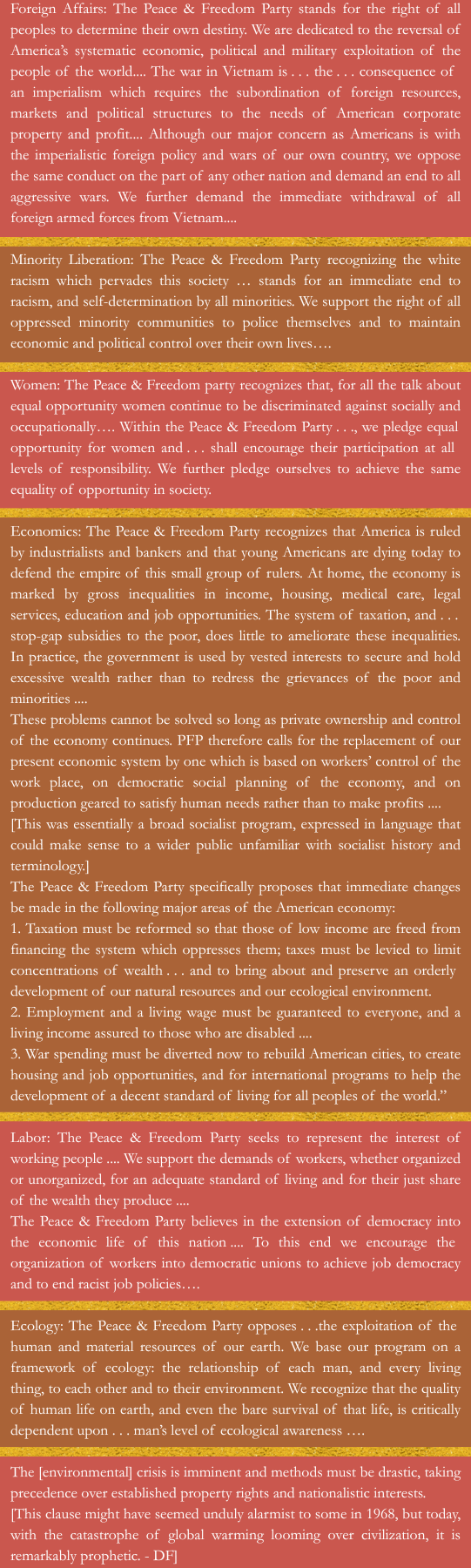
Other sections dealt with Personal Freedoms, Urban Affairs, Education, Student Power, and Health.
The PFP achieved at its first convention the organization of thousands of newly radicalized people into a democratic, membership-controlled, action-oriented political party; the establishment of a coalition between the Black and anti-war movements; and a radical program with broad appeal, a program which did not resolve ideological differences within the Left but addressed itself to major issues and practical measures for the reconstruction of U.S. society on a democratic basis.
Impact of liberal campaigns in the Democratic Party
Right after the mid-March Richmond convention, the PFP was faced with its greatest challenge: the campaigns of Eugene McCarthy and Bobby Kennedy for the Democratic presidential nomination, following Lyndon Johnson’s decision not to run for re-election. Once again, millions of people were subjected to the illusion that U.S. policy could be changed through the Democratic Party. Embryonic Peace and Freedom parties in other states died stillborn or remained more or less frozen at the few hundred members who were attracted in the beginning. The political conditions that had led to the sudden emergence of the California PFP were no longer ripe.
Thousands of people registered back into the Democratic Party in California, mainly in order to vote for Bobby Kennedy. The PFP membership dropped to about 70,000 during the next several months – still a large number, but a sign of things to come. It has been argued, via hindsight, that this “proved” that Peace and Freedom was unviable and a bad idea from the beginning. This is a faulty assessment. All it proved was that PFP registrants, being ordinary people without much political experience, could be attracted away from the road of political independence which only a few months earlier had never even occurred to most of them.
In the same time-frame, student radicals were becoming intensely frustrated over the war. With all the major left-wing currents contained in PFP, it was inevitable that the political turmoil of the larger New Left would find its expression there. A Radical Caucus coalesced inside PFP made up of campus-based activists who saw the defection of thousands of people as a good thing and were contemptuous of “liberals” in the party. With its expansion cut off by the competition of the Kennedy and McCarthy campaigns, Peace and Freedom became increasingly preoccupied with the much smaller and more radical Black Panther Party. The nature of PFP as a broad left-wing party, thus was squeezed from within and without. Here was a problem that PFP finally could not solve, for it involved social forces operating on a larger scale than the fledgling third party movement.
A party of struggle
Despite the more difficult political environment following its convention, the county PFP organizations entered a period of intense movement activity. The anti-electoralists in the New Left had warned that political action must inevitably water down the commitment to demonstrations, organizing, and militancy, but PFP demonstrated the fallacy of that formulaic idea.
PFP activists took part in organizing Stop the Draft Week – several days of militant mass confrontations with police – aimed at closing down armed forces induction centers. When Dr. Martin Luther King was assassinated in April 1968, establishment politicians made pious, tear-jerking speeches that stressed King’s non-violence, “lawfulness,” and role as a “man of peace” – failing to mention that he had led masses of people in struggle and had been jailed many times by local and state governments – and was supporting an “unlawful” strike in Memphis when he was assassinated. By contrast, PFP decided that King’s death was indeed a time to step up the fight for the racial and economic equality that had been King’s goal. Some five thousand people took part in a seven-mile march through Oakland to the County Courthouse, raising political demands on policing, economic assistance to poor people, and withdrawal from Vietnam, with conversion of war industry to full-employment peacetime production.
During this period, the PFP organized demonstrations against police atrocities, supported a strike by telephone workers, mobilized support for reform of the prison parole laws, began a drive to get the vote for l8-year-olds, challenged the gerrymandering of electoral districts by the major parties, and fought on local issues like the Santa Fe railroad tracks destroying a black neighborhood in Berkeley. The PFP supported the farm workers’ strike and boycott, publicized the independent political movement of Chicanos in New Mexico led by Reies Tijerina, and kept up a constant barrage of exposure and challenges against routine governmental policies that normally run roughshod over the interests of poor people, racial minorities, and anybody without money and influence.
Denouement
We skip over details of the depressing chronology of the runup to the November 1968 election, for lack of space and because it does not bear on our general purpose in this article. In brief, the PFP nominated the Black Panther Party Minister of Information, Eldridge Cleaver as its presidential candidate, mostly for lack of a credible alternative who was willing to run, and because Cleaver had played a positive role up to then. In a sudden turnaround that surprised everyone, immediately after his nomination Cleaver transformed the campaign into a farce, declaring an “alliance” with the so-called “Yippie Party,” demanding that PFP accept the cultural-leftist impresario, Jerry Rubin, as their vice-presidential candidate, and when all elements of the party including the Radical Caucus who adored him refused, denounced all of them. In the end, Cleaver abdicated in favor of the “Yippie pig.” There was no real presidential campaign. The PFP never recovered from this demoralizing blow.
The window of opportunity for a new party of the Left was closing rapidly, but Cleaver’s behavior made that essentially moot. Although the PFP was organized at the local level, the presidential campaign had immense symbolic importance because both the Vietnam War and Black liberation were national issues. The party needed a standard bearer; what it got was a betrayer.
Although tens of thousands of people were still registered members of the PFP, much of the life went out of the party. There was no real presidential campaign, nor was there much energy in the many state and local campaigns. By 1969 sixties radicalism was in its death throes, with the political and organizational collapse of SDS administering the coup de grâce. Not even the massive nationwide antiwar demonstrations of 1970 (as President Nixon expanded the Vietnam War to Cambodia) could revive the radical movement, which did not provide leadership to that dramatic expression of opposition to the war.
Eugene McCarthy won only 23 percent of the delegates at the 1968 Democratic convention in Chicago. McCarthy served out his remaining two years in the U.S. Senate, but refused to play a leadership role in opposing the Vietnam War.
After the 1968 election, Vietnam became “Nixon’s war.” Moreover, the war was being lost. Many Democratic politicians and liberal organizations were free to oppose the war, and the anti-war movement became more mainstream. Much of the opposition that had given rise to PFP was absorbed into liberal politics.
A small organization carried on in the name of PFP. Thousands of people remained registered, and the party was still on the ballot in California for the 1970 elections and for decades afterward. At some point in that period, the remnants of PFP declared itself to be a socialist party, which may have felt good but meant next to nothing. A number of campaigns were run, but with little success owing to the disintegration of the Left and the unfavorable political climate.
Summing up
The Mississippi Freedom Democratic Party in 1964 and the California Peace and Freedom Party in 1968 both grew out of disenfranchisement. The MFDP provided organization and a voice for black people denied all representation in that state. The PFP provided organization and a voice for people whose opposition to the Vietnam War was not represented by the Democratic or Republican parties. The coalition between PFP and the Black Panther Party extended that opposition to the struggle for Black liberation. In MFDP and PFP, the struggles over elementary issues – the right to vote and the right to have a voice on war – led to dramatic action and radicalization, contrary to the view of sectarians that only an ideologically correct organization is worth supporting.
None of these three organizations was explicitly or ideologically socialist. The Panthers were anti-capitalist and adopted some campist socialistic rhetoric in groping their way toward an international strategy (which included support of North Korea and other such regimes), but their program and activities were essentially an outgrowth and extension of the ongoing Black movement in the U.S.
In all three cases, independence from the Democratic Party was a politically liberating influence, in which the participants became free to develop and fight for programs, policies, and perspectives that would have been smothered in the Democratic Party or dissipated in anti-electoral abstentionism. Political independence is critical for mass movements, whereas for small socialist organizations it is most effective to the extent that they can influence sectors of the mass movements. It would serve Tempest, and other like-minded socialist groups, well to make an outward-oriented approach a cornerstone of our advocacy within the labor movement and the large social movements today, when political discontent is high but still mired in highly unpopular Democratic Party politics.
Opinions expressed in signed articles do not necessarily represent the views of the editors or the Tempest Collective. For more information, see “About Tempest Collective.”
Featured Image credit: Karl Wiener; modified by Tempest.
Categories
We want to hear what you think. Contact us at editors@tempestmag.org. And if you've enjoyed what you've read, please consider donating to support our work:
DonateDavid Friedman View All
David Friedman is a lifelong socialist in the democratic, labor-based Debsian tradition.