

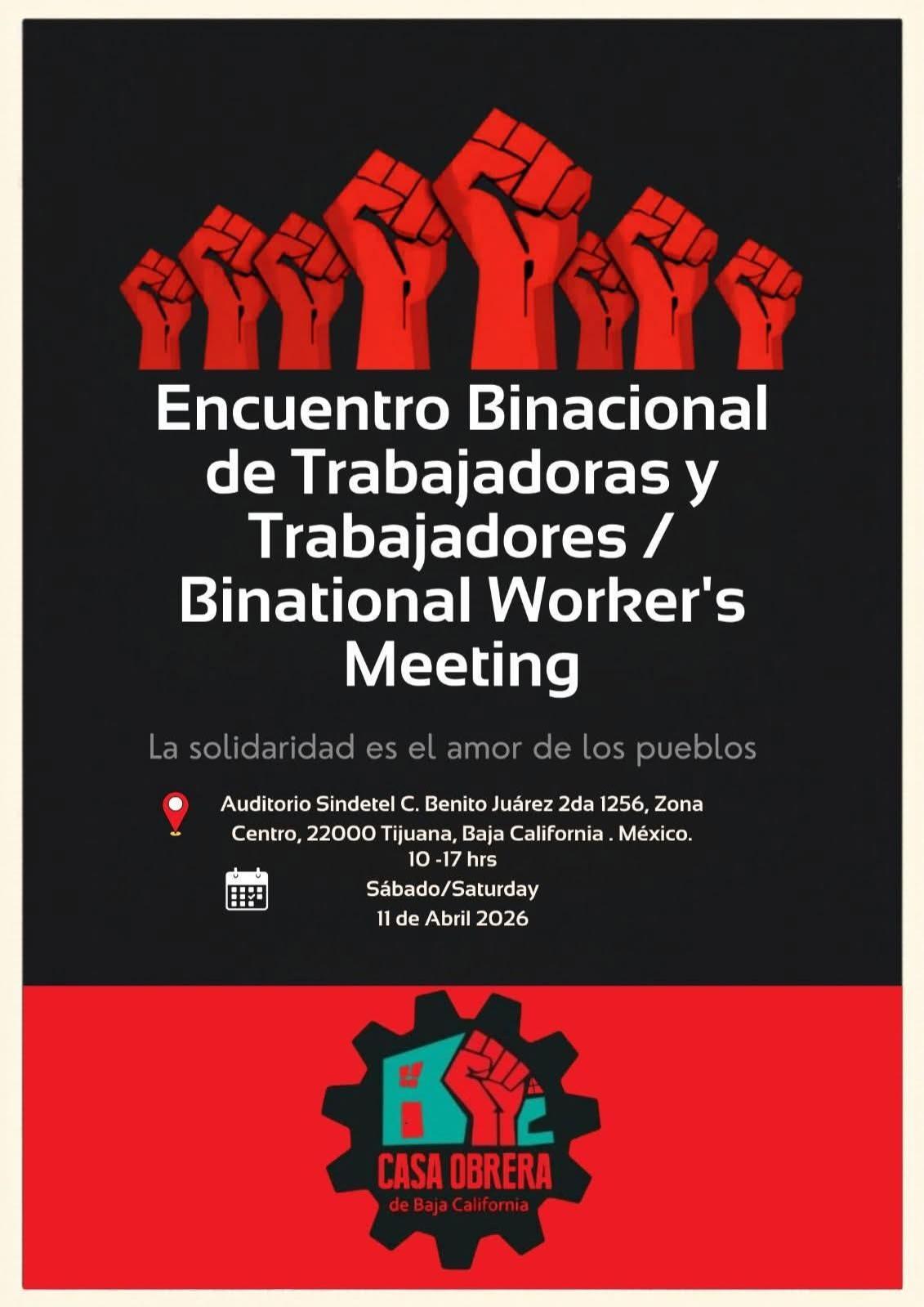
On April 11 2026, union members from Los Angeles and San Diego crossed the border into Mexico to attend the first Crossborder Labor Summit (Encuentro Binacional) in Tijuana since the late 1990s, organized by the Casa Obrera de Baja California, and hosted by the Telephone Workers Union of Baja California and Sonora (SINDETEL).
In recent years, there has emerged an increasingly combative, independent, and organized labor movement in Mexico’s maquiladora industry. It has resulted in largescale wildcat strikes like those of Matamoros workers in 2019, as well as in independent union campaigns in more established industries. Within this context, Casas Obreras, labor organizing centers, emerged as leading hubs of activity in Mexico’s main industrial regions.
The Casas Obreras have been supporting independent, democratic unions that challenge the traditional top-down unionism that has characterized Mexican labor for decades. For example, in 2022 the Casa Obrera del Bajio helped coordinate the victory of the newly organized National Independent Auto Workers Union (SINTTIA) at General Motors in Silao, Guanajuato. In 2024, the Casa Obrera de Baja California, supported the campaign by Luxshare workers to unionize their factory, the first successful independent campaign in the region since 1998. Most recently, they helped the Supply Chain Transporters Union, (SITRABICS) win the right to represent cross-border truckers.
The April meeting in Tijuana created a place for union workers from Los Angeles and San Diego to meet union workers on the Mexican side and learn about labor issues that affect workers on both sides of the border. The event was kicked off with a welcoming message by the Casa Obrera providing a historic background of the Mexican labor movement and labor organizing in Tijuana’s maquiladora industry. Organizers with the Labor Solidarity Action Network (LSAN) opened with a message of solidarity and critical analysis of Trump’s attack on labor and our democratic rights in the US.
Los Angeles brought a contingent of members from the United Steelworkers (USW 675 and USW 137M), SEIU 721, and a few educators. In San Diego, LSAN and SEIU 221 coordinated to bring a large contingent of educators from AFT 1931, AFT1474, UAW 4811 and the CFA. Others came from the flight attendants union, healthcare workers, and state employees. Members of the Tempest Collective, Socialist Horizon, and the Zapatista-affiliated Congreso Nacional Indigena were also in attendance.
Eddie Contreras, a member of USW Local 675, and worker for Savage Infrastructure at the Marathon refinery in Wilmington, CA was also in attendance at the labor summit. He and his coworkers recently organized a union at that workplace and successfully negotiated a first contract. He was impressed by the turnout and saw opportunities for collaboration: “The workers can all learn from one another. Maybe there’s something we tried at my job that they might want to try. Maybe there’s something they tried that we can try at my job.”
Mexican unions in attendance included the SINDETEL, SINTTIA, SITRABICS, UNTA (app/gig workers) and SINDJA, the National Independent Democratic Agricultural Day Laborers Union. UNTA members shared recent organizing updates and some success organizing app and delivery workers. SINDJA members attended the congress to express solidarity and thanks for past support in their own unionization campaigns in the agricultural fields of San Quintin, Baja California.
Based on the testimonies from Mexican workers, we learned of the difficult organizing conditions at such factories as Prime Wheel in Tijuana, maker of aluminum and alloy wheel rims, where workers have been organizing for democratic union representation. Since 2024, workers have called for justice and investigations of the disappearance of Servando Salazar Cano, a worker at Prime Wheel who was leading a unionization campaign in the plant but who mysteriously disappeared in the factory and has never been seen again. His body hasn’t been found, either, and his widow has called on authorities to carry out forensic investigations and accountability.
Alarmingly, journalists, environmental activists, and labor organizers in Mexico are at high risk of violent retaliation or human rights violations for carrying out advocacy work. In recent months, workers at the Camino Rojo mine in Zacatecas denounced management’s negotiations with the Sinaloa cartel to harass and intimidate a unionization drive. Since the case broke, the mining sector, led by Canadian companies, has been under scrutiny for sabotaging union elections. Orla Mining, the parent company of Camino Rojo, was forced to fire top executives thanks to a rapid response clause negotiated in the US-Mexico-Canada Agreement.
During the first half of the meeting, workers from both sides spoke about union elections. During the second half of the meeting, attendees split into working groups to discuss a series of questions focused on the common interests of workers in Mexico and the US. Participants discussed campaigns where US-based unions could support Mexican unions leading the independent labor movement through boycotts, protests, or public pressure campaigns. All working groups agreed to continue coordinating these campaigns and to meet once a year at a similar summit to assess progress and collaboration.
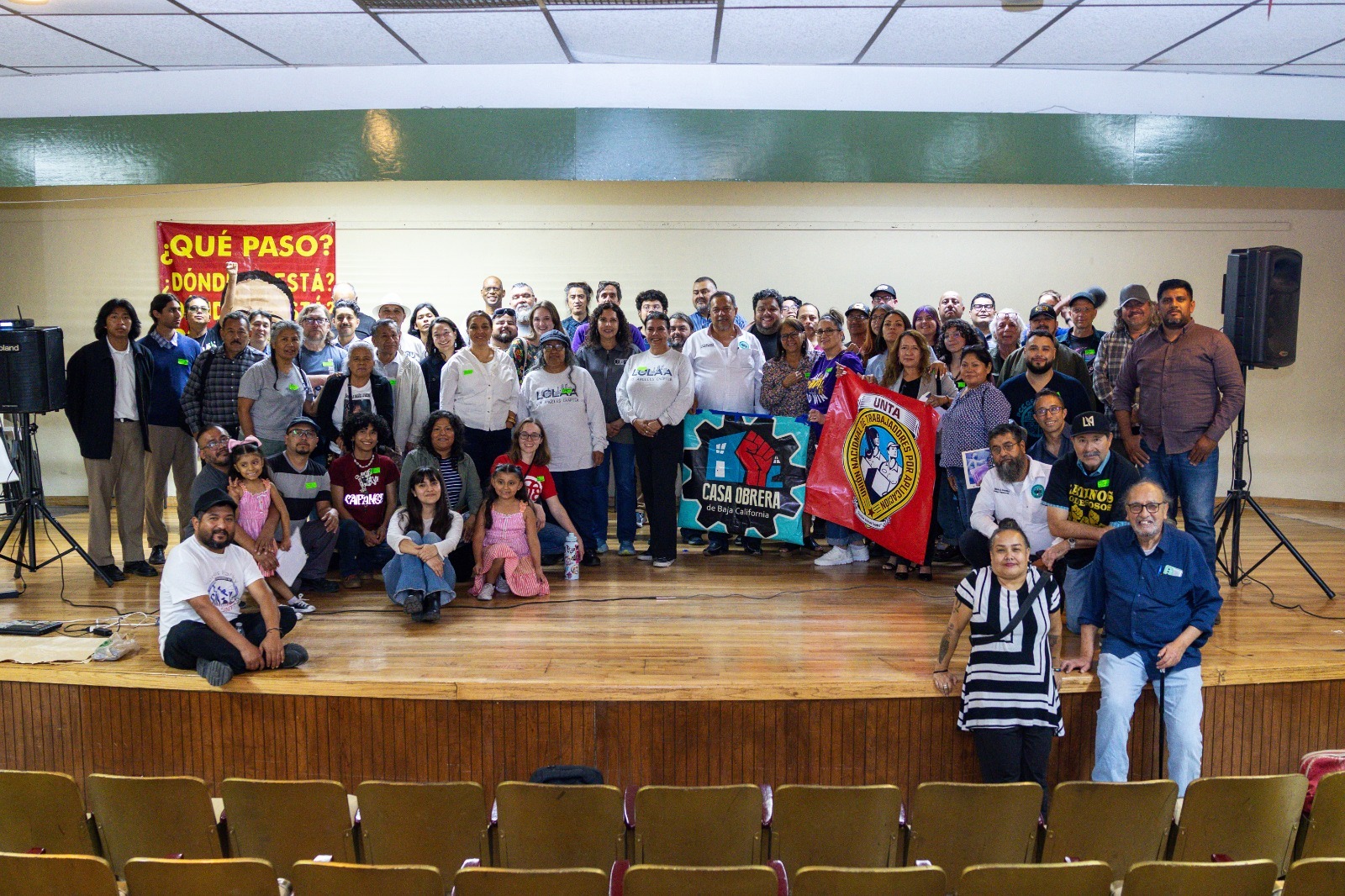
At the end of the Labor Summit, many participants had discovered common ground and common workplace issues. Jordan Dearden, the First Vice President of USW Local 675, who works as an Instrument Technician at the PBF refinery in Torrance, CA, stated,
The issues we’re having north of the border are the same issues as south of the border. It’s not a border thing. It’s just where you are; you need safer working conditions, better benefits, you know, equal pay for equal work. The issues that we have as workers are the same.
He also pointed out the importance of organizing crossborder meetings at a time when the Trump Administration continues to divide workers with anti-immigrant racism: “I think anytime you’re able to meet and work on a grassroots level, that’s really what impacts. This is how we change things.”
Since the April meeting, organizers on both sides have continued to coordinate efforts and disseminate information about this initiative to labor networks in Tijuana, San Diego, and Los Angeles. In recent weeks, the focus has been on contract negotiations at the Luxshare plant in Tijuana, where in 2024 SINTTIA won the first independent union in the region since 1998. The Luxshare workers, Casa Obrera de Baja California, and its allies hope to continue the string of independent, democratic, union victories.
Opinions expressed in signed articles do not necessarily represent the views of the editors or the Tempest Collective. For more information, see “About Tempest Collective.”
Featured Image credit: Héctor Rivera and Hannah M; modified by Tempest.