

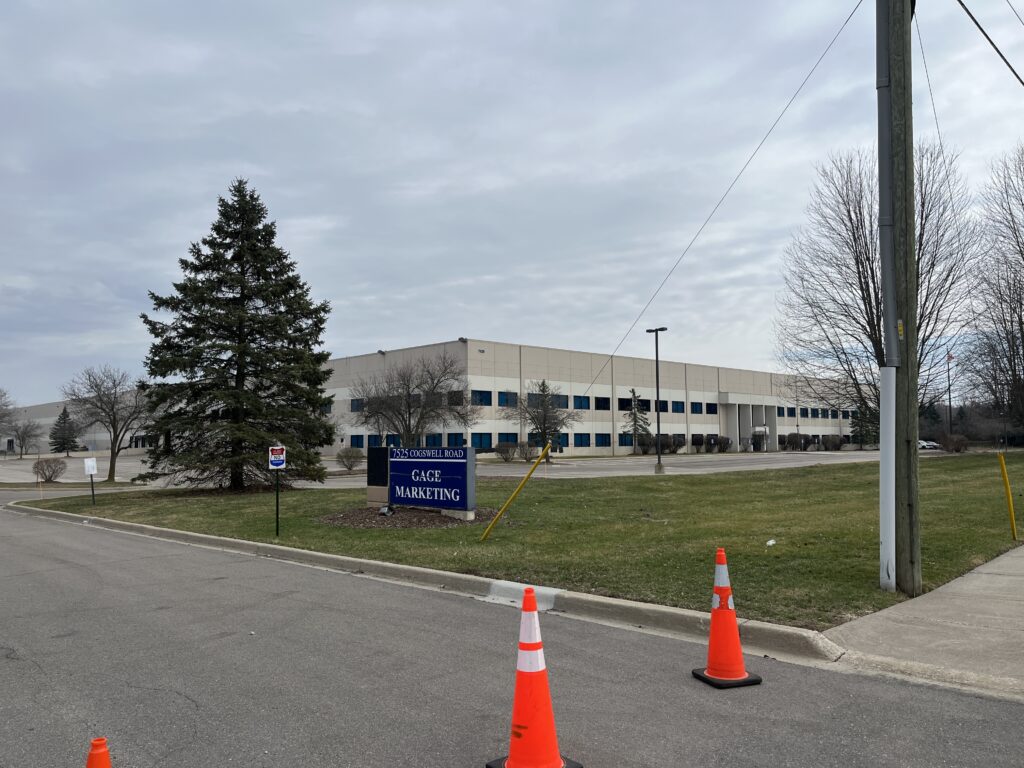
Romulus, Michigan is a city of 25,000 people 23 miles outside of Detroit and home to the Detroit Metropolitan Airport. In February, the Department of Homeland Security purchased an idle 250,000 square foot warehouse in Romulus for $34.7 million. City leaders and the community were kept in the dark as rumors circulated about the sale, including that it was sold at 56 percent more than the previous purchase price. After initial reporting on this sale, 300 Romulus High School students walked out and a thousand people gathered outside Romulus City Hall in late February when the reports were confirmed. On No Kings Day, March 28, another 350 to 400 people gathered for the Romulus No Kings at the warehouse. On Saturday, April 25, hundreds more gathered there for the Communities Not Cages National Day of Action.
A Coalition to Shut the Camps has developed out of weekly pickets at the planned detention center location. This coalition has produced a regulatory punch list and a package of letters sent to various state and local agencies demanding full transparency on all proposals and the opportunity for public meetings. The coalition has been leafleting homes and schools in the area, encouraging people to join weekly meetings and protests. Thirty-three organizations have signed onto the letters, and some are becoming partners in “Solidarity Saturdays,” collaborative events co-hosted by coalition members and other community organizations.
The National Day of Action on April 25 was called by the national coalition Detention Watch Network and involved the participation of other national organizations like Indivisible, Workers Circle, Public Citizen, MoveOn and many others. More than 200 events around the nation transpired as a result. The core campaign demands are to cancel the warehouse detention plan and stop conversions immediately; reject all public funding, approvals, and local resources for detention expansion; and require transparency and community consent before any federal detention action. In Romulus, the Metro Detroit Democratic Socialists of America, No Detention Centers in Michigan (NDCM), the People’s Assembly of Detroit, Southfield Neighborhood Action Committee (SNAC), and Community Aid for Empowerment (CAFE) from Pontiac came together with the Coalition to Shut the Camps to center the experiences of those at risk of being detained and those detained or recently released from detention.
The day of action in Romulus coincided with a hunger strike and work stoppage that began April 20 at the GEO Group owned-and-operated North Lake Processing Facility in the Village of Baldwin, Michigan (population < 1,000). The hunger strike and work stoppage were responses to the intensification of abuse in ICE detention, reflected by deaths in ICE detention entering a record high, and a continuation of unrest at the isolated Northern Michigan facility. From 2019-2022, there were multiple deaths and six separate hunger strikes at this immigrant-only federal prison.
Built in 1999 as the Michigan Youth Correctional Facility, North Lake has closed and reopened four times. Since reopening in June 2025 as the largest ICE detention center in the Midwest, North Lake has consistently imprisoned over a thousand people, many found by federal judges to be unlawfully detained. In recent months, a combination of reports of an increasingly unsafe environment, medical issues going unaddressed, and a steep decline in judicial approval of bonds has brought the North Lake detention center into the international spotlight. Following the death last December of Nenko Gantchev, an immigrant from Bulgaria who lived in the US for over 30 years, and the sharp increase in incidents requiring an EMS response, immigrants detained in Baldwin are demanding better medical care, adequate food, and their constitutional right to timely due process. They are also demanding conditions that allow for adequate sleep and an end to arbitrary rules.
No Detention Centers in Michigan (NDCM) has recently organized multiple protests and is calling for additional actions outside the Baldwin facility in solidarity with those incarcerated, such as blasting song requests from detainees with a loudspeaker to the inside. The strike has spurred calls from the ACLU of Michigan and Michigan Immigrant Rights Center for Congress to conduct formal independent investigations into neglectful and abusive conditions at North Lake.
The strike had been renewed as of April 27, despite claims by ICE denying any such assertion of the rights and dignity of those confined. A statement from a recently released immigrant affirming the courageous act of collective resistance by hundreds of immigrant men across multiple units in North Lake was read at the action in Romulus on April 25. A statement was also read there from Women’s Collective Civil Action, a group of women from another unit at North Lake who filed a joint habeas corpus petition earlier in the month. Many attendees of the Romulus demonstration made the 3.5 hour trek across the state to Baldwin the following day to express solidarity with those kidnapped from the broader region and subjected to the brutality of the state.
As Ale Rojas of NDCM put it, “This courageous collective action is a response to the dehumanization and abuse that are endemic to ICE detention, where immigrants are used as scapegoats so corporations like the GEO Group may continue to build their profits unchecked. Centering our humanity and the humanity of every person who has been kidnapped by ICE is the only way forward.”
Worsening conditions of confinement around the country and the expansion of ICE presence in Michigan with the purchase of the warehouse in Romulus has given rise to a deepened sense of alarm and more community opposition. The Ban Warehouse Detention Act would prohibit DHS from establishing, operating, expanding, converting, or renovating any warehouse or similar building for the purpose of detaining people. Congressmember Rashida Tlaib’s announcement of the bill on April 23 was a direct response to ICE’s expansion in Romulus and Southfield. She herself attended the Romulus No Kings demonstration organized by the Coalition to Shut the Camps on March 28 as well as demonstrations in Southfield opposing the leasing of office space to ICE. Her bill also addresses ICE’s plans to convert 23 such warehouses nationwide into new immigration detention and processing facilities, a plan that would expand the federal agency’s detention capacity significantly.
This legislation was drafted in partnership with Detention Watch Network and cites the likelihood that confining large amounts of people to spaces not meant for human habitation will increase the spread of illness and put people’s health at risk, increasing the chance for abuse and death in ICE custody. The group also suggests that such expansion normalizes mass confinement and will result in an increase in unlawful arrests, violations of due process rights and widespread family separation.
On April 25 in Romulus, the tenth demonstration since the end of February occurred in the city against the purchase of the warehouse by the federal government. The City of Romulus unanimously passed a resolution opposing the sale, citing proximity to nearby elementary and middle schools; negative impacts on the health, safety and welfare of Romulus residents; and negative impacts on economic development. Michigan Attorney General Dana Nessel has also joined with the City of Romulus in a lawsuit against DHS and ICE, alleging the federal agency failed to complete necessary environmental reviews and to consider alternatives.
The Communities Not Cages demonstration featured a teach-in with speakers from No Detention Centers in Michigan, the Coalition to Shut the Camps, Detroit DSA, People’s Assembly, CAFE, and SNAC. Organizers discussed the work they have been doing to address ICE activity in Michigan, the needs for future work, how to keep building out the organizing, and how different organizations can work together effectively.
Another demonstration and march occurred earlier in the day organized by local Indivisible groups. Between the two events, roughly 500 people demonstrated throughout the day against the plans for a detention warehouse in metro Detroit.
As in Los Angeles, Chicago, and Minneapolis, the potential for social upheaval has led to action, in this case Michigan Attorney General Dana Nessel’s suit against the DHS. The lesson taken from experiences around the country has been that local officials respond to organized mass pressure from below. With May Day following the day of action against warehouse detention, there was an opportunity to deepen the involvement of organized workers. The Metro Detroit AFL-CIO recognized International Workers’ Day for the first time in decade. Members organized a post-rally march to the Detroit ICE office, with a contingent for immigrants’ rights and against wars abroad.
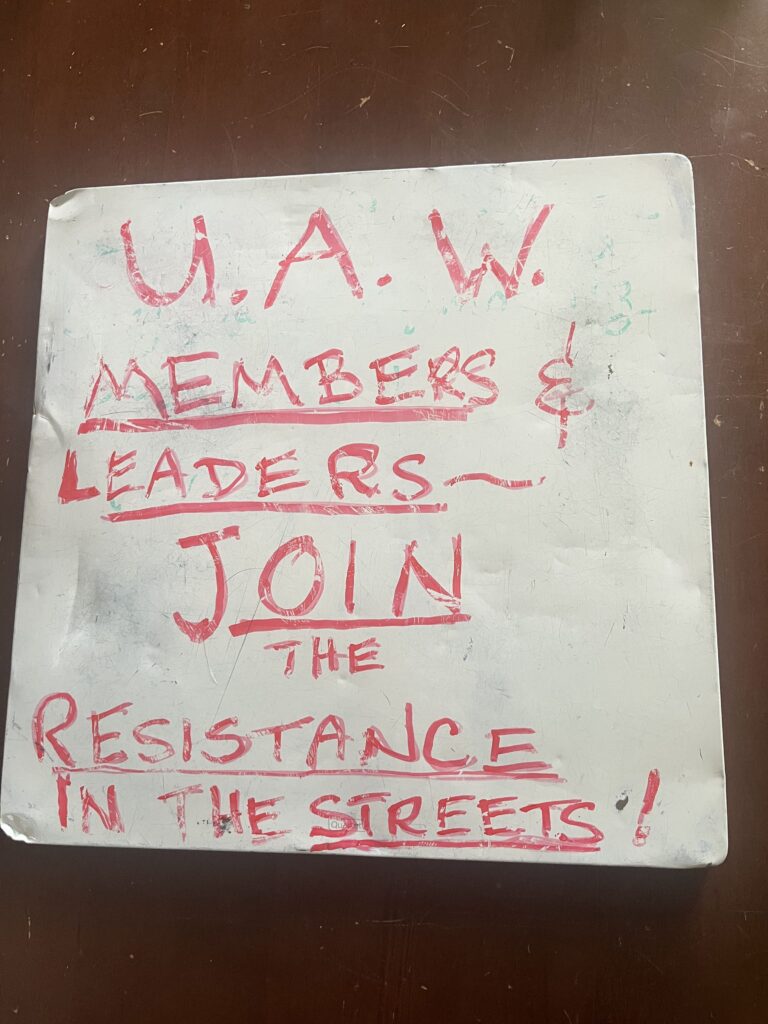
Union support against immigrant detentions is crucial. For example, in the nearby city of Wayne, the No Kings Day event was held at UAW Local 900, a major Ford production complex not far from the Romulus detention center project. That No Kings Day was largely focused on the movement against ICE. At a March 16 demonstration outside the Romulus warehouse, a member of UAW Local 900 expressed opposition to the warehouse detention plans. Ron Lare, a retired Ford worker and member of UAW Local 600 at the Ford Rouge plant, held a sign that read, “UAW members and leaders –– join the resistance in the streets!” Lare urged UAW members and leaders to come out to the protests at the detention center project in Romulus. “The union is supposed to stand for the principle that ‘An injury to one is an injury to all.’ It is inevitable that if this detention center opens, some UAW members will be detained inside.”
Against the violence and brutality of the state, there is space for exposing connections to attacks by the ruling class on people throughout the world. It is possible to deepen bonds of international solidarity that pose an alternative to the reactionary ethno-nationalism of the ruling class. The emergence of a detention state with a renewed focus on borders and exclusion is the latest phase of a long history of racialized criminalization essential to stratifying and regulating the labor-market that produces the wealth of capitalist society. Immigration enforcement is a tool of capitalist exploitation that creates a tiered labor market, providing employers with a pool of cheap, exploitable labor and exerting a downward pressure on wages and working conditions, limiting the bargaining power of the working class.
The creation of ICE in 2003, following the post-9/11 reorganization of immigration services, consolidated and militarized longstanding practices rooted in history. The struggle for immigrants’ rights must be rooted in multiracial solidarity that shatters the myth of American exceptionalism and exposes the violent foundations of capitalism and US imperial dominance. Only a united working class has the power to reorganize society on the basis of real democratic control and defend against the inevitable disappointment entailed by elite cooptation.
We must reject any hollow attempt to paint over the historical existence of racial capitalism and recognize it as the key task for socialists to actively strengthen and learn from the struggle for abolition. We must understand, as CLR James did, that those most oppressed in the class struggle “carry the hatred of bourgeois society and the readiness to destroy it” to a greater degree than other sections of the population. It is an essential question of strategy and power to center and uplift such voices in a bottom-up struggle that targets the foundations of capitalism.
The struggle against oppression is the prerequisite for organizing a democratic mass movement capable of confronting the ruling class. A socialist vision for immigration recognizes freedom of movement as a fundamental human right. Only such a vision can address global inequities that drive migration and fuel the fight to extend full labor rights to all workers, removing the incentive for employers to exploit undocumented labor. A genuinely internationalist solidarity can unite workers across borders and advance the global struggle against exploitation.
Opinions expressed in signed articles do not necessarily represent the views of the editors or the Tempest Collective. For more information, see “About Tempest Collective.”
Featured Image credit: Ben Solis/Michigan Advance; modified by Tempest.