
Ernst Meyer, Leninist
A review of “Revolution as Realpolitik. Ernst Meyer (1887–1930) – Biography of a KPD Chairman”
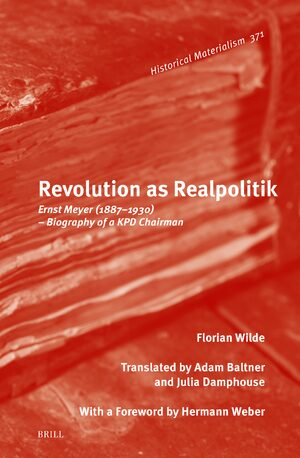
Revolution as Realpolitik
Ernst Meyer (1887–1930) – Biography of a KPD Chairman
by Florian Wilde
Brill, 2026

Poor, dear father! You died before turning 43, marked and condemned to death by tuberculosis and the brutal disappointments of a whole life sacrificed to the party; perhaps this saved you from Hitler, a concentration camp or liquidation in Stalinist Russia
Heinz Meyer, 1981
Ernst Meyer (1887-1930) has long been a forgotten figure of German communism. No longer. Florian Wilde’s breakthrough biography justly reestablishes Meyer as one of the most remarkable leaders of the German Communist Party (KPD), standing alongside Rosa Luxemburg and Karl Liebknecht. Meyer’s time in the KPD, whether as a leader or in opposition, provides Wilde with an “illustrative example of what democracy looked like in one Communist Party” (1) functioning in the most advanced capitalist society in Europe. From this reviewer’s vantage point, Wilde’s contribution compels a significant re-evaluation of the inter-relationships between the Communist International, the KPD, and Stalinism in Russia, as hitherto presented by Trotsky and accepted by many on the revolutionary Left.
Meyer joined the Social Democratic Party of Germany (SPD) in 1908. In 1910, he took his doctorate at Königsberg, and in 1913, he became an editor of Vorwärts (Forward), the main party paper of the SPD. Rallying to the SPD’s left-wing, he became an opponent of the First World War.
With World War I raging unchecked, Meyer, Luxemburg, Liebknecht, Paul Levi, Klara Zetkin, Heinrich Brandler, and others founded the Spartacus group in 1916 to oppose the SPD’s counter-revolutionary, pro-imperialist stance. In 1917, the left-wing of the SPD, pressured by the militantly anti-war Spartacists, split off to form the USPD. Led by Karl Kautsky, the USPD promoted ending the war and returning to the peaceful reformism and evolutionary socialism of the pre-1914 period. But there was no turning back. At the end of the war, revolution erupted in Germany and other countries. Millions of workers and tens of thousands of radicals like Meyer suddenly found themselves engaged in revolutionary activity, but without much clear understanding. Revolutionary impatience culminated in the Spartacist uprising of January 1919.
The uprising was supported by most workers in Berlin but not by workers across the country. The SPD and right-wing death squads repressed the movement in a bloodbath. Among the hundreds murdered were Luxemburg and Liebknecht, a catastrophic loss. Meyer broke down and cried when he heard the news. Arrested, he spent the next few months in prison.
In the run-up to the uprising, the Spartacus program had argued for a council republic and against calling for a constituent assembly in Germany. “Even more compellingly than the example of Soviet Russia,” Meyer observed, “the experiences of the German Revolutionary movement following the first November days must have led [Luxemburg] to revise her position”(80). Indeed, it did.
In her famous “Tragedy of the Russian Revolution,” written in prison in the summer of 1918, Luxemburg had denounced the Bolsheviks for dispersing the Russian Constituent Assembly in favor of Soviet (i.e. council) power, calling it an assault on democracy. No more.
When the Congress of the Workers’ and Soldiers’ Councils voted to hold elections for a national assembly, Luxemburg dropped her boycott demand and opted for participation — but without doubting for a moment that such participation still meant that bourgeois-democratic institutions were incompatible with working-class rule, or that both could be combined. In the 64 days she had left to rethink the revolutionary process, she had revised her position, agreeing de facto with Lenin on the question of the state.
At the founding Congress of the KPD in January 1919, Meyer joined the Zentrale, which was the party’s executive committee, as an elected member. The congress featured various currents distinguished primarily by their attitudes toward party democracy, democratic centralism, and, above all, the politics of the united front. In the party’s early years, a “distinct putschist element prevailed among the membership and was soon also reflected in party policy,” which adopted an “ultra-left” course (107). Meyer became, for a time, one of the most outspoken advocates of this trend and its “theory of the offensive”.
The KPD loathed the SPD leadership both for its support for the imperialist war and its role in suppressing the Spartacist uprising. The new KPD leadership, in 1919, rejected united-front politics, which required revolutionaries to relate tactically and flexibly to the SPD and other reformist workers’ parties. Instead, uncompromising revolutionary action by a minority would jolt the reformist majority into jettisoning their reformism, deserting their treacherous leaders, and embracing socialist revolution.
Yet by the time the KPD held its Second Congress in Heidelberg in October 1919 it had already taken the first small steps away from ultra-left abstentionism and sectarianism. A bare majority resolved to participate in elections and work in the reformist Free Trade Unions. This “likely necessary clarification and unification of its positions” on this and other issues came at great cost, however, Wilde notes (118). Half of the 107,000 members declined to comply with the Heidelberg resolutions and were consequently expelled, in accord with the principles of democratic centralism. Most joined the short-lived, ultra-left Communist Workers’ Party of Germany (KAPD), which refused to work with reformists wherever they might be.
In debates within German historiography, Wilde (and Marcel Bois) challenge the view, “repeated time and again in the scholarly literature,” that the Heidelberg Congress quashed inner-party democracy by expelling dissidents (28). Wilde points out that the expulsions were a consequence of extensive political debate, not simply directives from those in power. The expellees were always free to join another party, form their own, or leave politics altogether. For this review, the exclusion of dissidents without debate is not the metric of a Stalinist party exclusively: it encompasses parties from across the political spectrum, from social democracy to fascism.
Following his release from prison in December 1919, Meyer returned to the KPD’s leadership. In March 1920, the party faced a major challenge with the Kapp Putsch, a right-wing coup against the Weimar Republic planned by freebooting Freikorps units, nationalist groups, and certain factions within the army high command. Upon learning of the coup, the KPD immediately decided:
The revolutionary proletariat knows that it will fight the military dictatorship. Yet it will not lift a finger for the disgraceful and dishonorable government of the murderers of Liebknecht and Luxemburg. It will not lift a finger for the democratic republic that was but a poor mask for the dictatorship of the bourgeoisie…(121)
The working class did not share the KPD’s indifference to the political forms of the capitalist state. It sensed that military dictatorship and bourgeois democracy were not the same. Workers did more than lift a finger to stop Kapp in his tracks – they went on a general strike. 12 million people participated in a work stoppage initiated by the reformist trade unions, supported by the SPD and the USPD. “Workers armed themselves, attacked monarchist paramilitaries and formed a ‘Red Army’ that soon controlled large swaths of the Ruhr” (119). The KPD soon dropped its sectarian abstentionism.. The Kapp coup was defeated — but so were workers’ militias, which the Weimar government also disarmed.
The KPD’s inconsistent policies disappointed many workers. “The January battles laid completely bare the weaknesses of the young KPD; its leading members did not pursue a unified course, and the party was unable to lead the movement, which would have also necessitated breaking it off” promptly(109). The KPD paid a price at the polls. The USPD, which had resisted the putsch from the start, doubled its share of the vote in the June 1920 Reichstag elections, from 7.6 to 18.6 percent and nearly five million votes, whereas the KPD only received 1.7 percent and 580,000 votes.
The Kapp Putsch generated intense debate in the KPD, which Wilde describes in necessary detail. The debate was mostly tactical. Meyer insisted that “kicking” the leftward-moving USPD through radical action by the KPD would win the rank and file over.
Paul Levi, a leader of the KPD, and others called for negotiations with the USPD instead, rejecting what they saw as Meyer’s voluntarist “actionism” (128). Both positions mustered staunch support in the party leadership and in the rank and file. Levi’s closing remarks at the party congress anticipated Lenin’s “Left-Wing” Communism: An Infantile Disorder,” which was published later but written around the same time.
The Second World Congress of the Comintern opened in Moscow in the summer of 1920. Meyer was elected to the Executive Committee of the Communist International (ECCI). The Bolsheviks broadly attempted to draw syndicalist, anarchist, and left-wing Communist currents towards the Comintern. “Worldwide worker radicalization and the growing prestige of the Russian Revolution had moved numerous parties to attempt to join the Comintern, including many that could hardly be described as revolutionary or Communist” (131).
In 1921, Meyer took on leadership of the KPD as chair of the party’s Political Bureau. An important concern for German communists was the attitude the KPD should take toward the USPD. Wilde steps back to broaden the perspective.
In marked contrast to the KPD, the USPD had a mass basis of hundreds of thousands of workers yet, although many of them harbored revolutionary sentiments, the party leadership had often wavered during both the war and the revolution, hardly comporting itself in an unambiguously revolutionary manner. Moreover, how should the Comintern relate to figures such as Kautsky, who unified revolutionary rhetoric with passive practice like no other? From a Communist perspective, Kautsky embodied the wait-and-see attitude that had led to the Second International’s downfall (134).
Radicalized workers had flocked to the USPD because it had played a key role in resisting the Kapp putsch. It counted 300,000 members in January 1919, rising to 800,000 by the autumn of 1920. In the process, the USPD’s internal balance of power shifted towards its leftwing, raising the prospect of a unification with KPD. In October 1920, a special USPD party congress convened in Halle to decide. The USPD split. In a four-hour-long speech, Zinoviev persuaded the left-wing to join the KPD, while the right-wing continued under its old name. With the merger, the German proletariat could now boast of having a mass Communist party.
Meyer and the leaders of the newly united party (called the VKPD but soon reverting to the KPD), still remained enthusiastic about initiating offensives. Once again, they put the immediate overthrow of the government at the center of the KPD’s political action. This led to the March Action of 1921. It was a disastrous failure. Levi wrote an open letter bitterly attacking the KPD’s go-it-alone adventurism — the “greatest Bakunist putsch in history” — and again called for united front politics(154). But many in the KPD still would not learn the right lesson. “Majorities in the German party and the Comintern– not to mention Ernst Meyer himself– would not become convinced that this sort of politics made sense as a fundamental strategy as opposed to a temporary tactic until they had experienced the devastating practical effects of the “theory of the offensive” in the March Action” (141-142).
At the KPD’s August 1921 Jena Congress, Meyer discussed the “practical effects” of the March action. Meyer walked a fine line: how to acknowledge Levi’s criticism of the ultra-left action without also throwing the followers of the failed uprising under the bus, as Levi had done. Meyer’s self-critical speech adopted a conciliatory tone to persuade everyone to support the resolutions of the Third World Congress of the Comintern in favor of united front politics. “The adoption of the United Front policy meant a clear victory for the new center of the party around Meyer, who also triumphed in the election to the Zentrale.” Wilde notes that Meyer became “one of the most energetic champions of the new line, inspired especially by the positive practical experiences it generated for the Communists”(174). From this point on, Meyer would never call into question the fundamentals of united front politics.
The occupation of the Ruhr by French troops in January 1923 and the response of the Weimar government triggered an economic crisis in Germany. Inflation skyrocketed. Workers went on strike. The KPD sought to lead workers to victory through the politics of the united front, which was earning the party much support among the newly radicalized masses, and, as a result, a revolutionary situation seemed to be developing over the summer. A German October was on the horizon, many thought. However, fearing a repeat of the adventurist March Action, compounded by contradictory advice from the Comintern, the KPD backed down at the last minute. A planned uprising was canceled, except in Hamburg, where news of the cancellation had arrived too late. Hundreds of workers were killed and thousands sentenced to prison in the repression that followed. This was another disastrous setback which, incredibly, led to the penultimate gasp of ultra-leftism in the KPD in 1924-1925, an episode called the ‘Bolshevization’ of the KPD. Meyer did everything in his power to combat it.
In the historiography of the Russian and German Revolutions, much influenced by Trotsky’s writings, the KPD’s Bolshevization, as Zinoviev’s termed it, is almost universally understood as the final descent of the KPD toward an authoritarian party, a permanent turn away from the politics of the united front, the beginning of the party’s Stalinization. But Wilde soberly criticizes the late Hermann Weber, doyen of KPD scholarship, for overlooking the flaws of this long-standing interpretation.
Weber assumes an essentially linear transformation beginning in 1924 with the Fischer–Maslow leadership’s rigid ‘Bolshevization’ (which entailed expulsions of oppositional members, limits to free debate, ossified thinking, an increase in the power of the apparatus over the base and dependency on Moscow) and successively continuing as additional oppositional groups were expelled (492).
Wilde’s analysis tells another story. Bolshevization, as traditionally understood, was reversed. Meyer wrote a letter to the ECCI urging it to intervene against Maslow-Fischer leadership and their intoxication with ultra-leftism. The Comintern’s “Open Letter” from September 1925 “exploded like a bomb” and played a key role in the process. It was a near verbatim repetition of Meyer’s own letter. The ECCI removed Maslow and Fischer from the leadership, and Meyer regained “significant and at times even decisive influence within the party.” “Internal party democracy and freedom of debate” allowed dissidents to voice their opinions in the Communist press once again. “The expulsions of the ultra-left were countered by the reinstatement of previously expelled supporters” of united front politics. The “party leadership elected at the Eleventh Party Congress in 1927 was pluralistic in its make-up, with nearly all the currents (still) present in the party represented” (493).
This is a far cry from Stalinization. Why is this not properly recognized, at least in German and, certainly, Russian scholarship? A possible answer lies in Trotsky’s attitude toward Meyer, on the one hand, and Meyer’s attitude toward Zinoviev and Bukharin, on the other.
Meyer had a good rapport with Zinoviev. As president of the Comintern, Zinoviev supported Meyer’s efforts to remove KPD hotheads Maslow and Fischer from the leadership. Zinoviev’s successor to the Comintern Presidency, Bukharin, also entertained close relations with Meyer. Meyer’s “vision” – pursuit of united front politics – “essentially overlapped with that of Bukharin, the chairman of the Comintern,” writes Wilde (397). Bukharin, an exponent of “socialism in one country,” and Zinoviev, who was not, had the same united front politics in international affairs. To understand these connections, it is important to analyze domestic and international issues separately—even though they were historically linked.
Back in Russia, the Bolsheviks had launched the New Economic Policy (NEP) in 1921 to restore a ruined economy after a devastating Civil War. At its core, the NEP sought to enlist the small-property owning peasantry to voluntarily join the working class in socialist construction. In 1926-1927, the Zinoviev-Kamenev-Trotsky or United Opposition emerged to contest the Bukharin-Stalin leadership’s go-slow approach to economic development. Meyer sided against the United Opposition’s calls to fast-track socialist construction. When Bukharin himself broke with Stalin in 1928 over Stalin’s forceful measures to rob the peasantry of their surpluses in response to shortfalls in grain deliveries to the towns late in 1927, Meyer became an “unabashed critic”(416) of Stalin’s methods whereas Trotsky ‘critically supported’ Stalin’s ‘Leninist turn’. Meyer backed Bukharin, Rykov, and Tomsky, leaders of the Right Opposition, against Stalin and, behind him, Trotsky’s partisans.
Abroad, Stalin’s man in the KPD, Ernst Thalmann—a member of the Comintern IEC from 1924 and co-chairperson of the KPD beginning in 1925— was willing implement Third Period politics without demur. “Behind Thalmann’s back stands the opportunist Ernst Meyer,” Trotsky wrote, facilely (383). Either Trotsky did not know of Meyer’s opposition to Stalinist ultra-leftism outside Russia, in the KPD, which was also Trotsky’s position or, if he did know of it, Meyer’s incorrect anti-Stalinism inside Russia – Meyer’s pro-Bukharinism – was, in Trotsky’s eyes, a mistake that outweighed all other considerations. Trotsky’s enmity toward Meyer may explain Meyer’s absence in Trotsky-inspired scholarship. Meyer does not make the index in either Deutscher or Broué’s massive Trotsky biographies.
In any event, Stalin’s ultra-left turn in domestic policy was reflected in the Comintern. In June 1928, Third Period politics became mandatory for all communist parties. In Germany, this meant a return to the ultra-left, sectarian policies of the KPD’s early years, which had identified the SPD with Fascism.
In December 1928, Thalmann, with Stalin’s backing, expelled Brandler and his partisans for defying the new line imposed from above. Brandler went on to form the Communist Party – Opposition (KPO) to fight for a return to united front politics. Meyer decided to keep fighting within the KPD to achieve the same goal. His efforts proved vain. “He literally waged this struggle” for the KPD’s future “with his last drop of strength” (471). In the summer of 1929, the exhausted Meyer, who had suffered from lung diseases since childhood, checked into a sanatorium to treat his tuberculosis. He never left it. He passed away on February 2, 1930.
I cannot improve on Wilde’s summary:
In 1925, the Comintern had initiated the KPD’s turn away from ultra-left policy and back toward the united front policy and a certain degree of inner-party democracy. In 1929, however, it was no longer Zinoviev’s and Bukharin’s international but Stalin’s. The apparatus lost its globally revolutionary forces—the ones that pushed the KPD to shift strategy to the united front to boost Communist influence. Inner-organizational democracy had also fallen out of favor. In 1925, many still saw it as necessary, recalling earlier debates. By 1929, the Comintern had degenerated into an authoritarian instrument for enforcing Stalin’s power and that of his faction in the Communist movement and had become subordinate to the foreign policy interests of Russia’s bureaucracy (456).
Returning to discussions Meyer held in 1918 around adhering to the Third International, Meyer had parenthetically remarked that
[It] hardly made sense to make the Russian Soviet Republic, a product of historical coincidence, the leader in forming the i[nternational]. Rather, we thought that an international could only really be an i[nternational] if this i[nternational] were equally created by the most important workers’ organizations in the various states (131).
Truly, Meyer was right. The Russian Soviet Republic was the product of “historical coincidence,” a fluke. Not in the sense that the October Revolution was a bolt from the blue, and the social-property relations issuing from that revolution — NEP Russia (1921-1929) — arbitrary, but in the sense that scores of Marxes and Lenins could not have foreseen the peculiar combination of historical circumstances that created a lone workers’ state — and that in a predominantly peasant society. Meyer’s observation is the key to understanding why the international workers’ movement failed to realize socialism in any country in the 20th century: the counter-revolutionary role of the Stalinist state. In these concluding paragraphs, I draw out the international implications of Meyer’s obiter dictum and reconsider world history in the absence of Stalinism.
There is an enormous difference between workers fighting for socialism and seizing power in an advanced capitalist economy, such as Germany’s, and one that was not, Russia’s. The difference can be brought out this way: Hypothetically speaking, if workers had seized power in an advanced capitalist Russia, fully integrated in the world economy like Germany’s, there would have been a “natural” economic basis for the closest political cooperation between the revolutionary representatives fighting for socialist revolution in every country precisely because the victory of socialism in one country would have been immediately and directly dependent on the victory of the others, investing “a world communist party with supreme reality” as Trotsky put it. Unfortunately, and historically, the Third International lacked this natural economic basis.
Russian economic development under the Tsars was autarkic. The Tsarist state politically expropriated a surplus from an economically self-sufficient peasantry, exporting grain to the West in exchange for means of production. Once that state fell, politically enforced grain exports to the West ended as well and never revived during the NEP period. In short, the peasantry’s pursuit of its class interests isolated the Russian economy from the rest of the world. So long as the Bolsheviks retained an internationalist outlook, NEP Russia’s role in the Third International remained positive. But that outlook lacked a practical, material basis.
The Bolshevik-led political unification of the workers’ vanguards internationally was not grounded in political economy. It remained analytically distinct from the all-round economic unification of national economies enmeshed in the world market. This proved to be the Third International’s Achilles’ heel.
Owing to the historical specificity of NEP Russia, an autarkic approach to building “socialism” at the expense of both peasants and workers was enabled, though not pre-determined. Beginning in 1928, Stalinist policies effectively ended the October Revolution, dissolving the Bolshevik party and the NEP. This development had an epochal impact on the international labor movement. In the name of ultra-left Third Period politics, Stalin purged the so-called rightists at home and abroad. In truth, the rightists were Leninists fighting Stalin’s ultra-leftism in Russia, as well as Stalin-supported ultra-lefts in the Comintern, including KPD. The Third International thus transformed from a revolutionary, if occasionally bungling, vanguard into an unwaveringly counterrevolutionary “frontier guard” of Stalin’s blood-soaked tyranny.
Arguably, the reversal of the October Revolution in 1917 or the defeat of the Bolsheviks in the Civil War might have led to more balanced political conditions among major European workers’ organizations in their collective pursuit of socialism, as Meyer noted. In this alternative scenario, the KPD would have pursued a united front policy between 1929 and 1933, successfully opposing Nazism and potentially establishing a workers’ state in Germany. A Soviet Germany would have inspired similar movements across Europe and potentially worldwide within an abbreviated period.
However, as Marx observed, historical traditions significantly influence contemporary thought and action. Trotskyist (and Stalinist) historians tend to overlook individuals such as Meyer, since these figures don’t easily conform to established classifications. This tendency makes it more challenging to reconstruct twentieth-century history from a materialist perspective, beginning with 1917 or 1921. How much easier it is to build castles in the air and indulge in blue sky thinking instead! Thankfully, Wilde’s meticulous archival research has notably advanced our ability to address these historiographical challenges, which are at the same time political encounters.
Opinions expressed in signed articles do not necessarily represent the views of the editors or the Tempest Collective. For more information, see “About Tempest Collective.”
Featured Image credit: Isaak Brodsky; modified by Tempest.

We want to hear what you think. Contact us at editors@tempestmag.org.
John Marot View All
John Marot is the author of The October Revolution in Prospect and Retrospect: Interventions in Russian and Soviet History (Brill 2013). His essays have appeared in Jacobin, New Politics, Against the Current, Historical Materialism, as well as specialized journals in the field.